CARLOS SANDOVAL MENDOZA
Mextoys
Germany, 2003–2004 · 80 minutes
Three Percussions, dance, tape and two video-interludes
With the kind collaboration of Yolanda Gutiérrez
Performers: Diego Espinoza, Trinidad Martínez, and José García
Premiere: 2003, Hochschule für Musik und Theater, Hamburg
Further performance: 2003, Goldbekhaus, Festival Eigenarten, Hamburg
Commission by Festival Eigenarten and Culture Ministry of Hamburg
Curator HMTH: Peter Hammel
Mextoys grew out of La Pasión según la Gente — the same vision, stripped to its material core. If La Pasión revealed the Passion play as a collective game that everyone agrees to play while knowing it's staged, Mextoys asked what a game actually is: an automated behavior, a learned repetition, a body doing what it was programmed to do.
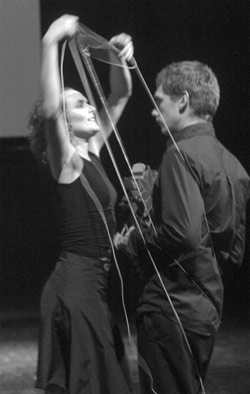
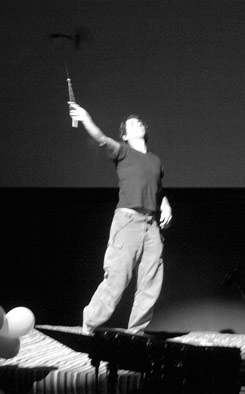
Three percussionists play Mexican folk toys — manual automata, butterfly toys, superhero figures, carousel toys, ping pong balls — not as props but as instruments, with the same seriousness a child brings to play before he knows the difference between playing and performing. The toys point to something specific: the early automated learning produced by mass elementary education systems, the body trained to imitate before it learns to think. A dancer moves through the same logic.

MEXTOYS: VIDEO INTERLUDE 1
ADULT CONTENT
|

MEXTOYS: VIDEO INTERLUDE 2
ADULT CONTENT
|
Two video interludes divide the piece into three parts. The videos are documentary — no fiction, no staging. A popular street celebration in Mexico. Naked bodies playing and having sex, unselfconsciously, with the same repetitive logic as the toys — the title Mextoys deliberately echoes sex toys: the mechanization of intimacy is not separate from the mechanization of play, of learning, of desire. A brief silent take of people dancing at a party: without music, the dancing bodies reveal themselves as machines, their movements suddenly legible as programmed behavior rather than expression.
What the stage theatricalizes, the video documents. What the video documents, the stage handles differently. Some elements belong only to one world, some cross between them — but the two worlds never fully coincide. The audience sits at the threshold between fiction and document, unable to resolve them into a single frame. The piece does not help.
MEXTOYS: A TOY IN-BETWEEN
Mextoys was my first fully realized multimedia piece, and the first in which I consciously placed humans as machines at the center — not as a metaphor but as an observable condition. Looking at humans is like looking at a machine zoo. This is where I first recognized the nature of my relationship to society: not as something outside of me but as a social-acoustic field in which I was already embedded — coordinated, repetitive, and not nearly as free as I had assumed.