ES

CARLOS SANDOVAL MENDOZA


La Pasión Según la Gente

Mexico, 2000–2002

Banda Filarmónica Juvenil de Tejalpa, Roberto Zerquera (Perc), Fernando Domínguez (Cl)

On-site recording technicians: Miguel Rodríguez, René Blancas and Marcos Deli

Production: Sireña


Premiere: 2001, courtyard of the Museo de la Ciudad de México
Curator and stage technician: Marcos Deli

2002, 500-CD Edition: Quindecim Recordings-Sireña, QD01153, out of print


Financial support: H. Ayuntamiento de Jiutepec, PACMYC Morelos


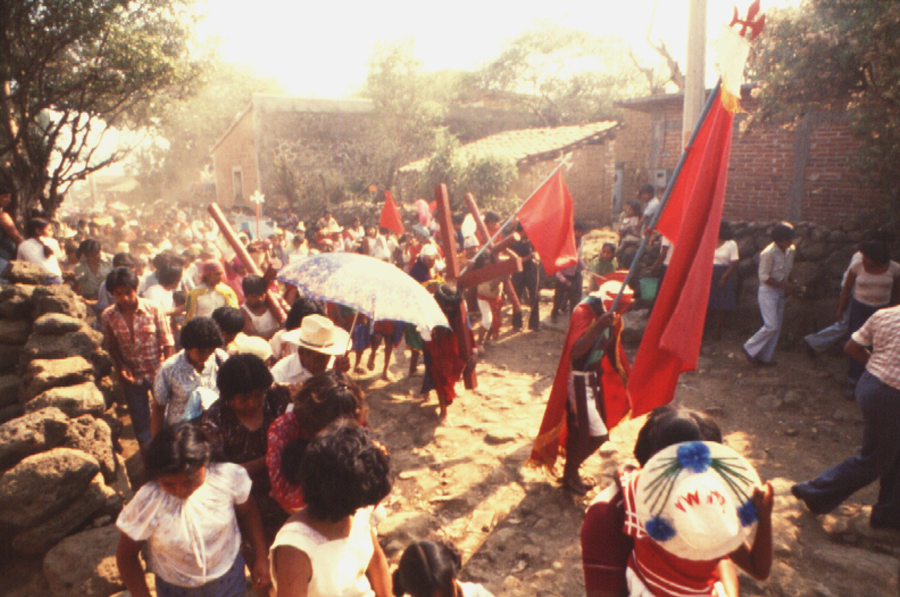
Passion of Christ procession in Ocotepec: a crowd carrying wooden crosses and red banners moves along a dusty village street, a figure in red robes at its center

MIGUEL RODRÍGUEZ, THE PASSION OF CHRIST IN OCOTEPEC, MEXICO, 1997


Every year in Ocotepec (back then a small town, in the center of the country), the community stages the Passion of Christ across nearly four square kilometers of streets, hills, and vacant lots. Everyone plays a role: neighbors become soldiers, one neighbor is chosen as Jesus, a young woman becomes Mary, and, with complete conviction, the whole town performs its own myth. The communal tradition inhabits a story that everyone believes in and nobody mistakes for “reality.”

For my part, I sent three recording technicians into this celebration with few instructions: “Move freely, no predetermined paths, no fixed positions. If you run into each other, no problem, but don’t stay together for long.” Jesus moved through the space along the planned route of the Via Crucis: a gravitational presence, sometimes surrounded by all three microphones, sometimes approached by none.
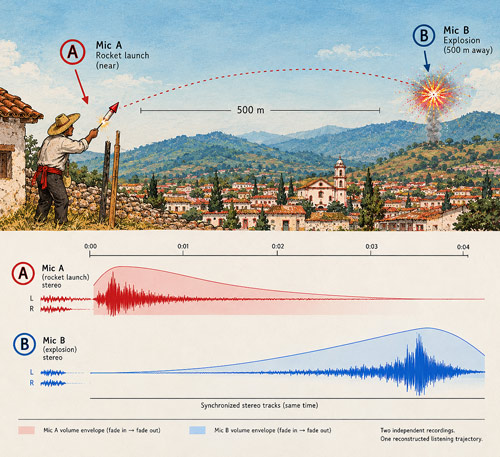
Diagram of sound perspective: microphone A at a firework launch, microphone B at its explosion 500 meters away, and the listener traveling between them by volume control

GPT-PROMPTED: REAL ROCKET TRAVEL AND MULTICHANNEL SOUND PERSPECTIVE IN SYNC.

The three resulting DAT tracks were synchronized and mixed into a single stereo track for use on stage and on the CD. In the edit, I shifted the relative volumes of the three simultaneous recordings, altering the listener’s perceived spatial relationship to the sound sources. This allowed me to construct listening trajectories that no one could have traveled physically.

For example: one microphone, A, captures the launch of a firework by a man whispering a prayer, and another, B, captures its explosion 500 meters away, along with a person also quietly praying; simply by controlling the volume of the two already synchronized recordings, the final listener can “travel” 500 meters in seconds, from the launch to the explosion at that distance, realizing at the same time that two people were praying all along. Although the rocket and the prayers share a sound perspective, the rocket is pure acoustics; the prayers, simultaneous yet far apart, also share semantic weight.
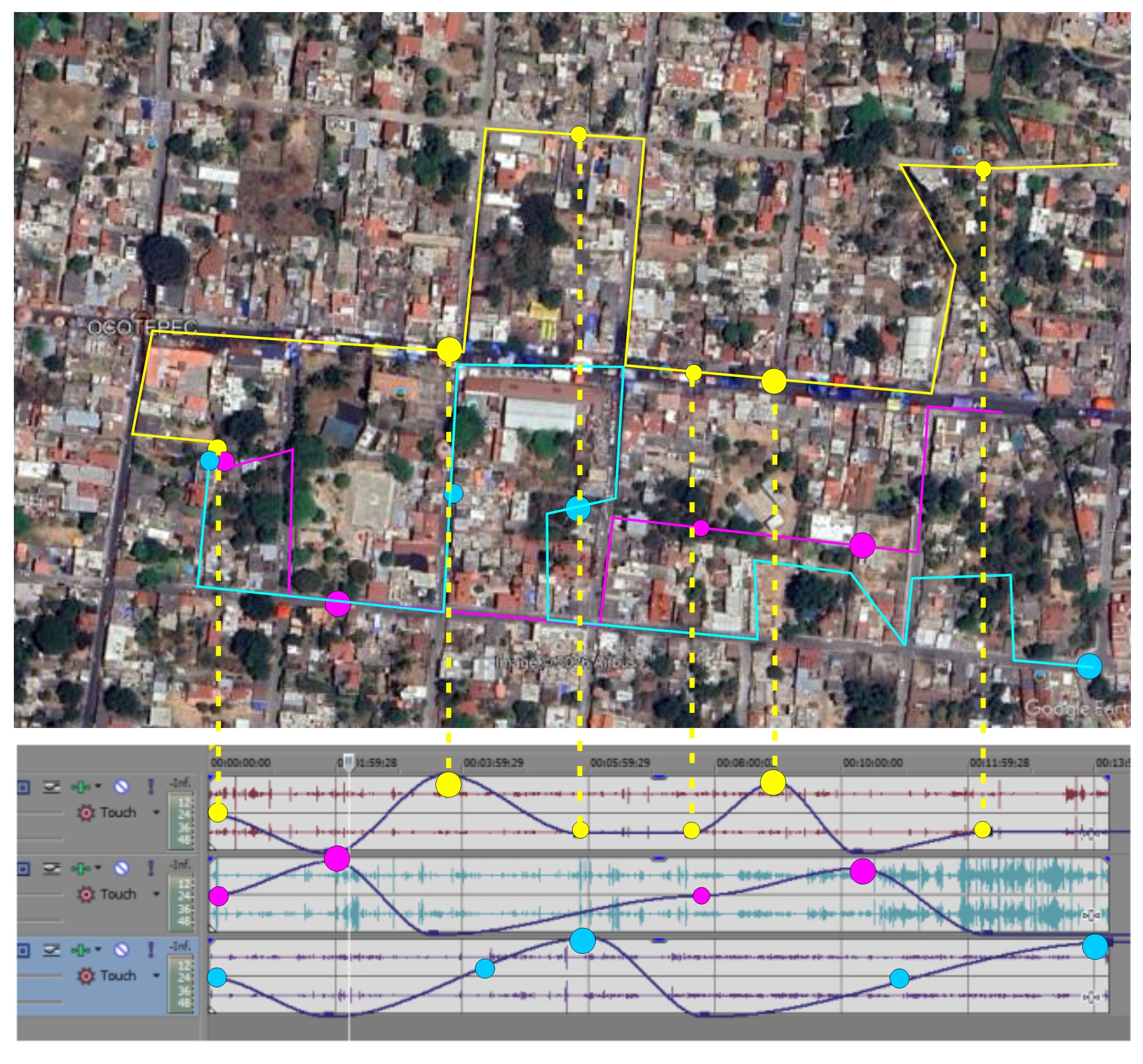
 

Diagram of the variable geography: nonlinear spatial perspective recording routes from the three DAT recorders

VARIABLE GEOGRAPHY: NONLINEAR SPATIAL PERSPECTIVE RECORDING
3 STEREO TRACKS MIXED SO THAT, ON STAGE, THE LISTENER “TRAVELS” THROUGH THE CELEBRATION.
(ONLY YELLOW RECORDER LINKS SHOWN, FOR CLARITY)


At the premiere, percussion, clarinet, and brass band played on stage while the tape came from a pair of speakers placed behind the audience. The museum’s arcaded courtyard became, temporarily, a kind of “town”: the brass on stage and the vendors, car horns, and crowd on tape fell into the same attractor field, a complex, non-hierarchical mass. La Pasión según la Gente is the mother piece of much of what followed: Mextoys, The Mexican National Anthem, Teleprompter, Hearing in Bed, Fatalismo Mágico, and others. The question I first asked (what is “collective behavior” when everyone is sincere and performing at the same time?) has not stopped producing answers.


La Pasión Según la Gente

JESUS WAS PART OF A SIMPLE WORLD