ES
CARLOS SANDOVAL MENDOZA
Field Logic
Berlin, 2026
Download PDF

MAGICALTOWNS.MX
Abstract
I propose Field Logic as a relational framework for understanding how coherence, symbolic abstraction, collective behavior, and perceptual organization emerge through interaction rather than centralized control. Rather than treating fields as fixed systems or purely material structures, I approach them as dynamic threshold conditions that become perceptible through participation, coupling, synchronization, instability, and lived experience. This framework also examines how technological and computational mediation can be intrinsic to latent coherences across distributed artistic processes, where perception itself becomes capable of generating emergent form. I did not design this framework in advance. I found it gradually while mapping decades of work across sound, performance, installation, and technological mediation — between bodies, environments, rituals, machines, atmospheres, and social behaviors. With it, I name what the practice was already doing before I had language for it.
I. Being Together
Humans as Field-Producing Beings
Human beings do not encounter the world as isolated observers. We move through it together, constantly forming relations between bodies, sounds, gestures, objects, memories, technologies, environments, and shared behaviors. Before art, science, religion, or politics separate into distinct domains, there is already a more elementary condition: the tendency to organize experience relationally.
This process is not always discursive. It often happens through rhythm, repetition, synchronization, imitation, ritual, and collective perception. Humans seem unable to stop producing shared experiences through which the world becomes less opaque.
A crowd moving together, a ritual chant, a tuning system, a dance, a myth, or an abstract drawing inside a cave may all be understood as attempts to produce coherence within an unstable reality.
In this sense, we are essentially field-producing beings.
A field begins to appear when relations between elements start generating recognizable conditions of coherence. These forms may stabilize temporarily or remain turbulent, but their organization arises through interaction rather than being fully imposed from outside. This understanding of perception as relational rather than observational moves close to what Tim Ingold describes as dwelling within an environment rather than standing outside it analytically.
Many of the oldest cultural traces already suggest this condition. Prehistoric markings, rituals, rhythms, and symbolic repetitions often remain partially inaccessible to us, yet they still reveal internal coherence and perceptual consistency. They do not feel arbitrary. They suggest collective ways of orienting experience whose coherence survives even when their original explanations no longer do. The structural relation between symbolic form, gesture, and collective formation explored by André Leroi-Gourhan remains particularly relevant here.
II. Collective Abstraction
How Symbolic and Non-Discursive Experiences Emerge
Human groups do not only organize themselves socially or materially. They also generate symbolic systems through which experience becomes collectively perceptible and interpretable. These formations may appear as myths, rituals, rhythms, gestures, images, spatial arrangements, tuning systems, or abstract forms whose meanings are never fully stabilized through language.
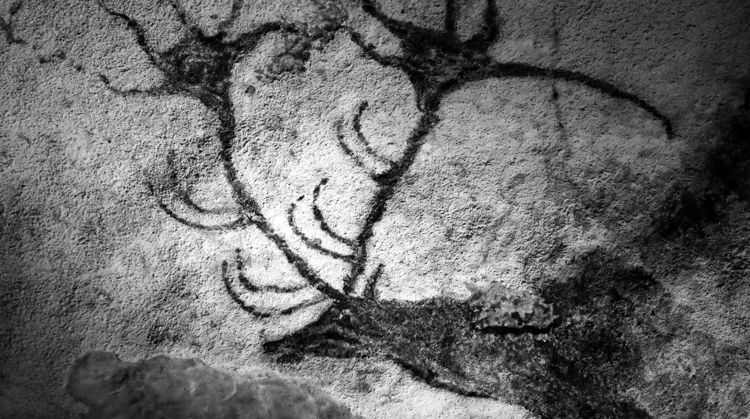
LASCAUX
Not all forms of meaning emerge discursively. Some appear first as shared intuitions, atmospheres, repetitions, or perceptual organizations that resist direct explanation. A rhythm may already contain a social formation. A ritual gesture may organize relations long before its symbolic meaning is formally articulated. An abstract drawing, a collective chant, or a repeated movement may produce recognizable coherence even when its conceptual content remains partially inaccessible.
This condition can already be sensed in some of the oldest human cultural traces. Prehistoric cave markings, geometric signs, ritual repetitions, and hybrid symbolic forms frequently appear to contemporary observers as simultaneously "structured" and opaque. Their original meanings often remain unavailable to us, yet they continue to reveal internal coherence. The work of David Lewis-Williams is especially important in understanding how symbolic abstraction, ritual perception, and altered states may converge within prehistoric image systems.
Such forms may not primarily represent the world. They may instead organize relations to it. Meaning does not always precede experience. Sometimes it emerges through shared practice, as people gradually stabilize perceptions, rhythms, symbols, or behaviors together. Collective abstraction is therefore understood not as the opposite of experience, but as one of the ways experience becomes perceptible in common.
This perspective complicates the modern image of authorship as the isolated origin of symbolic form. Rituals, myths, melodies, and symbolic systems often stabilize across generations without belonging entirely to a single creator. Authorship does not disappear, but becomes distributed across bodies, repetitions, memories, environments, and shared practices.
Collective abstractions are also rarely pure or fixed. Categories that appear opposed — sacred and profane, order and noise, rational and irrational — often coexist within the same field conditions. Symbolic systems leak into one another, absorb contradictions, and reorganize themselves continuously. The anthropological understanding of ritual developed by Roy Rappaport is especially useful here, particularly in relation to how repetition stabilizes collective symbolic formations without eliminating internal tension.
What stabilizes them is not only repetition but the creative tension between what a symbol claims to be and what it actually does — what the back cover of the Spanish edition of Masa y Poder names, in a phrase I have carried for decades, as "la dialéctica de los símbolos." The German forest, assumed as "pastoral," "romantic," "natural," is read by Canetti as "a vertical army," "uniform," with every tree "in formation." The symbol works precisely because both values coexist without resolving. The romantic and the military are the same symbol, held in productive opposition. This is what makes symbolic systems so durable — and precisely for that reason, so vulnerable to being broken.
Fields also encounter one another asymmetrically. Dominant symbolic systems frequently reorganize weaker ones according to their own operational logic. This does not necessarily happen because understanding is impossible, but because full relational understanding is often unnecessary for administration, extraction, exploitation, or control. Complex symbolic worlds are therefore simplified, translated, renamed, fragmented, or absorbed into systems that are easier to manage. What disappears in these situations is often not the form itself, but the relational conditions that originally allowed the form to function coherently within lived experience.
III. Field Formation, Field Logic
Temporary Organization Within Movement
How does coherence arise when nobody is fully in charge of it?
I do not impose structure on my work. I construct conditions under which coherent formations can emerge, and then I observe what happens. Form arrives through coordinated behavior between bodies, materials, technologies, environments, and cultural patterns. What appears as composition is often something else: the moment a dynamic situation begins to stabilize, when elements align, drift, interfere, or coexist without anyone having fully prescribed the result.
I call this Field Logic. The term emerged gradually from the work itself rather than from existing literature.
This framework shares certain affinities with concepts of chorality, particularly in its attention to plurality, coexistence, and collective presence. Both move away from singular authorship and centralized organization, focusing instead on situations in which multiple elements operate simultaneously without collapsing into unified identity. The distinction, however, lies in the level at which coherence emerges. Chorality primarily concerns the coexistence of voices, bodies, or perspectives within a shared space, while here I focus on how relations between heterogeneous elements — human, acoustic, technological, symbolic, or material — generate emergent coherence through interaction. For this reason, it operates less as a political or moral proposition than as a descriptive framework for understanding how organization, synchronization, instability, conditioning, or fragmentation emerge across distributed systems.
A field does not emerge automatically wherever interaction exists. It takes shape only once relations between elements generate recognizable collective tendencies. This constellation is not necessarily planned, and it does not always depend on centralized control. In many cases, stable organization appears precisely because no single element fully determines the result.
Field formation occurs through coordination. Bodies, sounds, gestures, materials, technologies, and social behaviors begin adjusting to one another under shared conditions. Local actions gradually produce collective consequences, while collective dynamics feed back into individual behavior.
A crucial condition in these processes is coupling. Many systems interact, but not all interactions generate fields. Coupling occurs when elements begin affecting one another reciprocally and continuously. Once this happens, organization begins to arise through mutual influence rather than hierarchical control.
This does not require conscious coordination. Crowds, rituals, musical ensembles, processions, technological systems, or repeated gestures may all generate forms of collective coordination without centralized direction. In such situations, organization develops through ongoing adjustment, drift, interference, synchronization, and partial stabilization.
In some works this logic operates through sound, where coordination becomes audible — a shared acoustic field forming between performers who are not directly communicating (Teleprompter, Nubes y Nomadas, Maquina Latina, Antilegos, Die Basta Zeiten sind vorbei, Mosaicos, Die Tränen der Dinge) and yet still arrive somewhere together. In others it unfolds through movement, objects, sensors, or editing processes, where behavior gradually reveals itself as patterned, conditioned, or socially synchronized.
When this logic operates through sound specifically, I call it Acoustic Fielding. And when pitch is involved — how groups of people or instruments tune to one another, drift apart, stabilize temporarily, or fail to synchronize — I work with what I call Social-Acoustic Tuning Systems (SATS): a way of understanding pitch not as a fixed property of sound, but as an emergent condition produced collectively through interaction. Tuning becomes a condition of the field rather than a measure of individual accuracy. It changes depending on scale, density, coupling, and the degree of interaction between participants.
Within this framework I distinguish five regimes:
| Deterministic Systems |
where pitch relations are explicitly defined and uniformly stabilized (my early pieces, for instance); |
| Lattice Systems |
where multiple internally consistent pitch systems coexist without merging; |
| Attractor Systems |
where loosely coupled individuals converge toward shared auditory targets without explicit instruction; |
| Uncoupled Acoustic Fields |
where sound coexists without stable relational alignment; and |
| Artificial Coherence |
where agents never coexist — each acts alone, at a different time, even if they share the same reference. Coherence is assembled afterward. The intuitive, almost biological interaction between living beings is replaced by crude synchronization. |
Synchronization, however, even if computational, should not be confused with perfect alignment. Fields rarely operate through total uniformity. A crowd singing together may never fully synchronize pitch, yet still generate a coherent acoustic field. A procession may drift rhythmically while maintaining collective direction. A technological system may remain functional despite local inconsistencies and interruptions.
For this reason, instability is not treated here as the opposite of coherence. Noise, fluctuation, divergence, and turbulence are often constitutive elements of the field itself. Coherence frequently depends on the system’s ability to absorb instability without collapsing entirely.
These concepts did not begin as theory. They emerged from practice — from La Pasión según la Gente, where three technicians moved freely through a four-square-kilometre celebration with no predetermined paths; from The Mexican National Anthem as I recall it from my childhood, where many schoolchildren sing the same melody in a turbulence of frequencies that never resolves into a single pitch; from Biberdamm-Assut, where beavers and musicians produce the same hocket without knowing it; from Maquina Latina, where nested human inaccuracies generate a metronome no machine designed.
IV. Material, Ethereal, and Technological Fields
Machines, Mediation, Automation, Distributed Systems
Fields do not emerge only between people. They also form between materials, infrastructures, environments, machines, signals, interfaces, atmospheres, and technological systems. Human coordination is always entangled with non-human processes.
A technological field is not simply a tool being used by a subject. Once systems interact reciprocally with bodies, behaviors, decisions, and environments, they participate in the production of the field itself. Sensors modify movement. Interfaces reorganize attention. Algorithms shape perception. Editing systems restructure temporality. Machines coordinate human behavior as much as humans coordinate machines.
Mediation, then, is not secondary to experience. It becomes one of the conditions through which experience becomes perceptible and collectively organized.
Some fields operate materially through architecture, acoustics, objects, circuits, infrastructures, or environmental conditions. Others operate through more diffuse and difficult-to-localize conditions: memory, atmosphere, symbolic density, ritual expectation, collective attention, emotional contagion, or technological presence distributed across networks and interfaces. A field may therefore appear simultaneously material and ethereal, physical and perceptual. In different ways, the atmospheric imagination of Gaston Bachelard resonates with this understanding of space as something emotionally and symbolically inhabited rather than merely occupied.
“Early in the morning, the fields are covered by moisture that arrived silently during the night. My tent is wet, and so am I. As the temperature rises, the water slowly lifts again into the air, forming low clouds above the plants before disappearing once more. The vapor feels like something returning up there, where it came from — like a lost soul finding its way back — as if the landscape itself were breathing through cycles of appearance and disappearance.”
In those moments, still wet, I felt entirely part of the field. I felt implicated in it, as if the landscape had taken part of me in order to become perceptible to itself. This is an ethereal Field Logic: a field not organized through explicit coordination, but through atmosphere, transition, diffusion, transformation, and perceptual continuity. The field appears not as an object, but as a temporary condition distributed across relations between air, temperature, ground, moisture, my skin, memory, and perception.
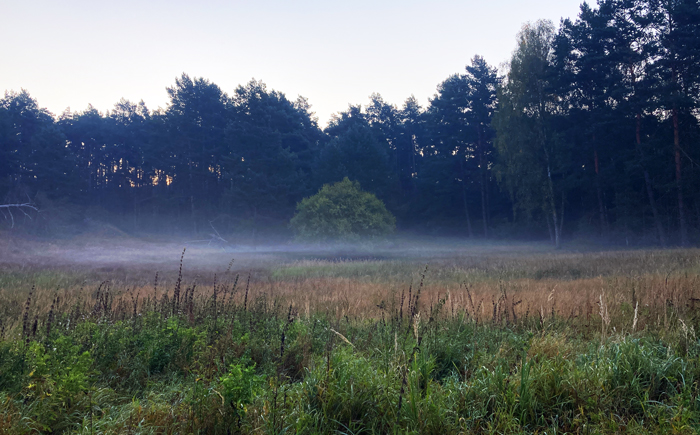
C.S., "Flying Tree": A Sereno Landscape, Biesenthal, Barnim, Germany, Sep. 2024
Not every relation becomes a field within experience. Many interactions remain inert, even when materially present. Fields become perceptible to me when they begin stimulating, reorganizing, or propagating creatively through lived experience. Accordingly, this emerges less from detached observation than from processes of implication, contamination, attention, and transformation. The field is not simply something I observe outside myself; for it to exist, it has to begin acting upon perception until perception itself starts generating form.
This also applies to automated and distributed environments — social rituals, bureaucratic procedures, technological habits, musical conventions, algorithmic feedback systems, institutional structures, communication networks, platforms, logistical infrastructures, financial systems, media ecologies, and other machinic arrangements. These conditions do not constitute fields merely by existing materially. They become fields when they begin reorganizing perception, behavior, attention, memory, or creative response from within lived experience.
Bibliography
Anthropology, Ritual, and Collective Organization
• Gregory Bateson. Steps to an Ecology of Mind. University of Chicago Press, 1972.
• Tim Ingold. The Perception of the Environment: Essays on Livelihood, Dwelling and Skill. Routledge, 2000.
• Roy Rappaport. Ritual and Religion in the Making of Humanity. Cambridge University Press, 1999.
• Claude Lévi-Strauss. Structural Anthropology. Basic Books, 1963.
• Victor Turner. The Ritual Process: Structure and Anti-Structure. Aldine, 1969.
Symbolic Form, Perception, and Abstraction
• Susanne Langer. Feeling and Form. Charles Scribner’s Sons, 1953.
• Ernst Cassirer. The Philosophy of Symbolic Forms. Yale University Press, 1953–1957.
• Gaston Bachelard. The Poetics of Space. Beacon Press, 1958.
• Maurice Merleau-Ponty. Phenomenology of Perception. Routledge, 1962.
• Canetti Elias, Masa y Poder, translation into spanish by Horst Vogel, Alianza/Muchnik, 1995.
Prehistory, Cave Art, and Non-Discursive Symbolism
• André Leroi-Gourhan. Gesture and Speech. MIT Press, 1993.
• André Leroi-Gourhan. The Dawn of European Art. Cambridge University Press, 1982.
• David Lewis-Williams. The Mind in the Cave: Consciousness and the Origins of Art. Thames & Hudson, 2002.
Art, Agency, and Distributed Authorship
• Alfred Gell. Art and Agency: An Anthropological Theory. Oxford University Press, 1998.
• Nicolas Bourriaud. Relational Aesthetics. Les Presses du Réel, 1998.
• Bruno Latour. Reassembling the Social. Oxford University Press, 2005.
Sound, Chorality, and Collective Sonic Organization
• Jeremy Woodruff. “Composing Sociality.” In Sound, Music, Affect: Theorizing Sonic Experience, Bloomsbury, 2013.
• Brandon LaBelle. Acoustic Territories: Sound Culture and Everyday Life. Continuum, 2010.
• Pauline Oliveros. Deep Listening: A Composer’s Sound Practice. iUniverse, 2005.
• R. Murray Schafer. The Soundscape: Our Sonic Environment and the Tuning of the World. Destiny Books, 1977.
Systems, Emergence, and Complexity
• Edgar Morin. On Complexity. Hampton Press, 2008.
• Humberto Maturana and Francisco Varela. Autopoiesis and Cognition: The Realization of the Living. Springer, 1980.
• Ilya Prigogine and Isabelle Stengers. Order Out of Chaos. Bantam Books, 1984.
• Manuel DeLanda. A New Philosophy of Society: Assemblage Theory and Social Complexity. Continuum, 2006.
• Jorge Wagensberg (ed.). Proceso al azar. Tusquets Editores, Barcelona, 1986.