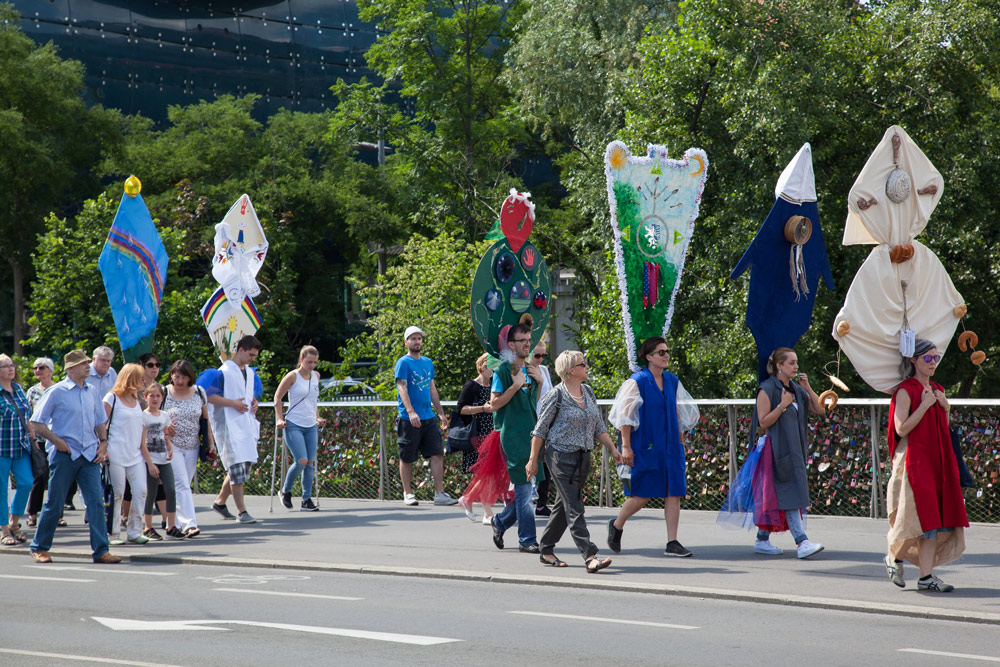
On our first scouting trip to Graz, Austria, for this project, I noticed empty niches inserted into the corners of some 19th-century buildings, which surely once held religious sculptures. An empty niche in the corner of a building, nine meters up, is an easy walk past — but the same "observation tic" that once fixed on a street sweeper whistling as she worked (Fatalismo Mágico), or on a dog trembling from time to time at a mosque entrance in Istanbul (Sinus-Köpek) — that compulsive kind of observation was the synaptic trigger for this piece.
We asked the commissioners to research the processions' traditions in Graz, but specifically in the villages around the city, in the Alps. An enormous tradition and an intense history of processions in the Alps were evident, which we were unaware of: processions called "Perchtenlaufen," an ancient tradition whose origins were the celebrations for the coming, longer days. Plain cosmic matters once kidnapped by Christian institutions.
The Grazer Kunstverein organized a meeting with one of these traditional groups, which led to a documentation carried out in parallel to the project, on my own initiative, and in which members of the community collaborated with enthusiasm. The comments on this video on YouTube keep surprising me: most contemporary locals are not only unaware of this tradition's origins, but in many cases despise it.
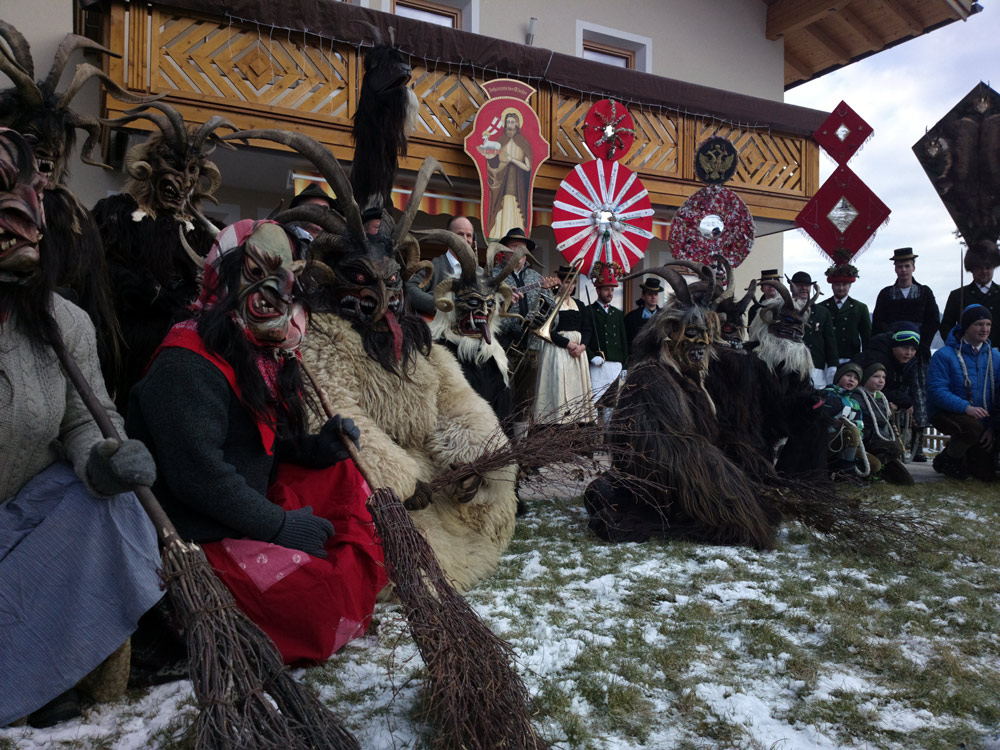
PERCHTENLAUF, ST. JOHANN IM PONGAU, DOCUMENTARY BY C.S.
We decided to integrate a local brass band. I composed the short looped pieces they performed and created a simple two-band choreography for each. The bells of several churches were included. These audios are demo-tapes for rehearsals.
Brot (excerpt)
Tanz der Peces Ausentes (excerpt)
Urzellen (excerpt)
Friedhof des Lebens (excerpt)
According to people who still practice this tradition in the Alps, the Church conditioned the survival of these processions on a substitution: non-religious objects had to be replaced with religious symbols. This substitution was never unique to the Alps. In Galicia, the Ara Solis — a Celtic altar to the sun on Cape Finisterre, with worship documented since the 6th century BC — was, according to legend, destroyed by Saint James himself, who built a chapel on the same ground. Across the region, thousands of roadside crosses, the cruceiros, are widely believed to stand where menhirs once did, a cross grafted directly onto older stone. The Church placed these symbols at crossroads to erase a pagan belief in a nocturnal procession of souls, the Santa Compaña — and, by its own later admission, achieved the opposite: villagers took the cross itself as proof that the procession was real. Religion did not erase what came before it. It stood on top of it.
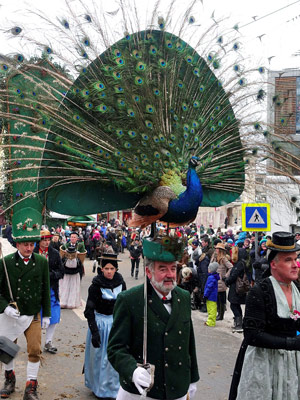
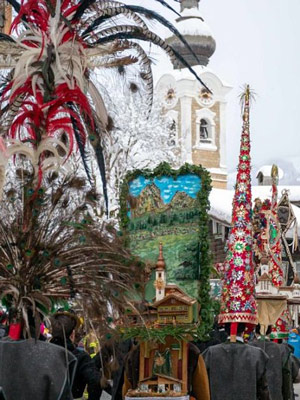
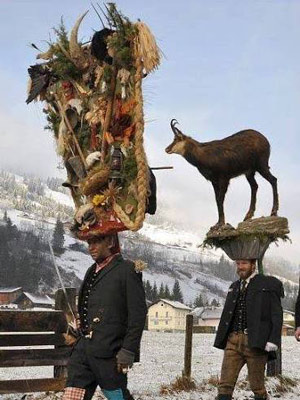
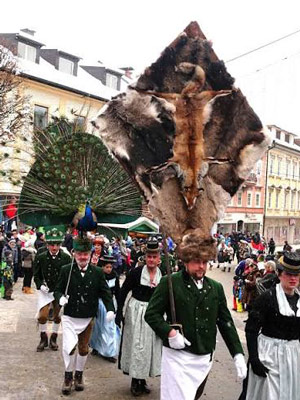
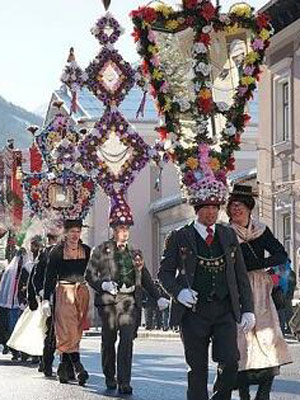
SEVERAL TRADITIONAL PERCHTENLAUF STANDARDS.
Our piece draws from this tradition, without claiming to represent it. The enormous creative freedom of the standards left us deeply impressed and became our source of inspiration: they reflect a kind of "frozen interaction" between the inhabitants and their environment — or at least a nostalgic view of their environment: taxidermied animals, household objects, plants, and various geometric forms, carried on the back like "portable cosmovisions," mixing two- and three-dimensionality, with a sense of mixed elements of internal (households) and external (landscapes under control) spaces. That sense of control over nature is not universal — it is not the Pachamama of the Andes, nor Tláloc, a living and omnipotent nature; nor is it the relationship indigenous Mexican communities held with the buffalo before European invasion and genocide replaced it with something else entirely; nor is it, further north, the Sami's relationship with the reindeer in Scandinavia. Europe itself once had something closer to this: cave paintings, therianthropic figures, and the pre-Christian processions themselves suggest a living nature that accompanied rather than served. It was Christianity that put an end to it. Just two of many documented examples: Frankish kings fined those who made vows at sacred springs and groves as early as the 8th century, and the Council of Nantes, in 895, ordered the destruction of trees consecrated to what it called demons.
Viertel nach Schatten thus turned out to be a mixture of tradition, community participation in the construction and design of the standards, a contemporary procession that seemed out of place in the contemporary life of Graz — announced, moreover, by the bells of four rarely visited churches — and an exhibition at the city's Orangerie, where the standards were displayed as the [15 minutes after the] shadows of a tradition most locals, as those YouTube comments showed, no longer know or practice. As a mother-cell of Fatalismo Mágico, Viertel nach Schatten showed as much complexity as its follower.