CARLOS SANDOVAL MENDOZA
TELEPROMPTER 2 AND NUBES Y NOMADAS 2 (BELOW)
Germany, 2014–2016
For ensemble and six-channel video
On stage: Cl., Ob., Vl., Vla., Kb., Perc.
On video: the same musicians
Music concert, street performance, and video art
Version 1 premiere: Resonanzraum, Hamburg, 2015
Version 2 premiere: Akademie der Künste, Berlin, 2016
Ensemble Mosaik, both under Enno Poppe
Commission: NDR-Das Neue Werk, Ensemble Mosaik
Version 2 produced with the support of the artist's SNCA fellowship (Sistema Nacional de Creadores de Arte, Mexico)

The work opens with six musicians reading a text aloud, written as rhythm and disguised as language. The instruction is to read it as an elderly "African" villager recounting a near-fatal encounter with a lion. No further guidance is given. What follows, spontaneously and without apparent self-awareness, is a spectrum of responses ranging from neutral delivery to unmistakable cultural mimicry. I make no editorial intervention. The discomfort this produces is precisely calibrated: the audience watches educated, culturally aware professionals activate reflexes embedded in a shared cultural field — without knowing they are doing it. The mechanism, not the individual, is on trial.
Angela Merkel closes the section — a New Year's Eve address, accelerated into stop-motion. At this speed, the distinction between the Chancellor performing national optimism and a musician performing a lion story collapses entirely. Speech becomes rhythm. Authority becomes just another modulation of collective perception.
In the street, six musicians follow a portable teleprompter through Berlin, reading a percussion score — pure rhythm, tones freely assigned — ignoring the city with total commitment. On stage, each performs a second score derived from what the street produced, written on four-line staves with the fifth line absent, its position left to individual imagination. Behind each performer, their own street video plays. Live and recorded, fixed and imagined, six performers and six prior selves — none of it fully separable.
The concert hall, Teleprompter and Nubes y Nómadas suggest, has always been a teleprompter: an institutional frame that transforms reading into interpretation, compliance into expression, and the performer's obedience into the audience's aesthetic experience. It is one of the most durable acoustic fields we have — and one of the least examined.

TELEPROMPTER - STAGE RECORDING AND VIDEO
NUBES Y NÓMADAS 2
Germany–Spain, 2021
For ensemble and six-channel video
On stage: Vl., Db., Sx., E-Guit., Pno., Perc.
On video: Fl., Cl., Vl., Trb., Toy piano, Perc.
Music concert, street performance, and video art
Version 1 premiere: Vertixe Sonora, 2022
Version 2 premiere: BKA-Berlin, Unerhörte Musik Series, Vertixe Sonora, 2024
No conductor
Commission: Ensemble Vertixe Sonora
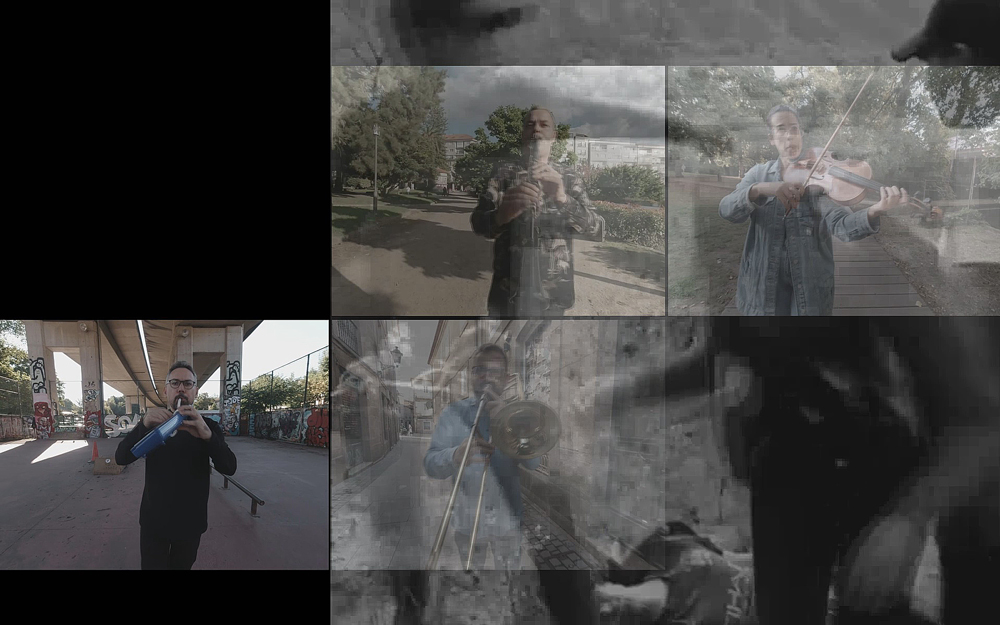
Nubes y Nómadas uses the same fundamental mechanism as Teleprompter: musicians walk through a city following a portable teleprompter displaying a rhythmic score. The score itself remains largely the same, but everything around it changes — instrumentation, geography, image architecture, and ultimately the political gravity of the work. The piece suggests that musical identity does not reside in notation alone, but in the larger perceptual and behavioral fields surrounding it.
Where Teleprompter was filmed in Berlin using the same musicians both on stage and on screen, Nubes y Nómadas was recorded in Pontevedra, Spain, with different performers for the street videos and the concert stage. This separation expands the instrumental field and destabilizes the idea of a fixed performing body. The individual screens used in Teleprompter disappear and are replaced by two larger video fields where musicians overlap with downloaded YouTube footage showing migrants crossing deserts, collapsing from exhaustion, or being violently mistreated. The performers and the migrants gradually begin to appear as part of the same migratory system: bodies moving under instructions and forces they did not author.
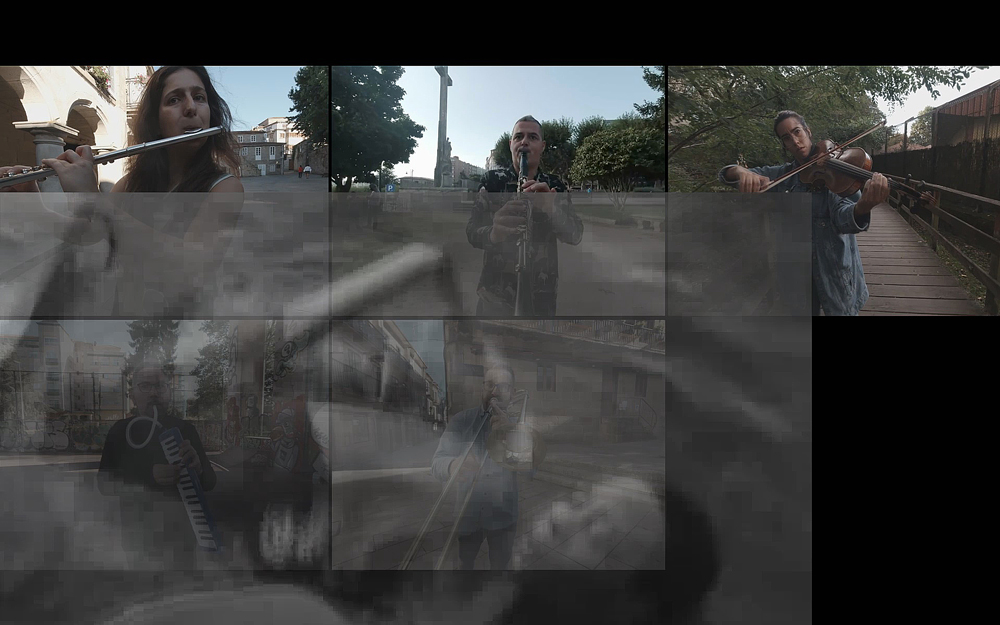
Throughout the work, musicians continue walking through Pontevedra with complete concentration, as if carried by an invisible behavioral current. But at the end, the music suddenly disappears while black-and-white footage of migrants being pushed back with massive streams of pressured water continues alone in complete silence for nearly a minute. The audience, already conditioned by the concert structure to keep watching attentively, remains behaviorally trapped inside the situation.