An Anti-Soundscape
Guillermo García Pérez, La Tempestad, September 8, 2016 · ← Se fueron los pájaros
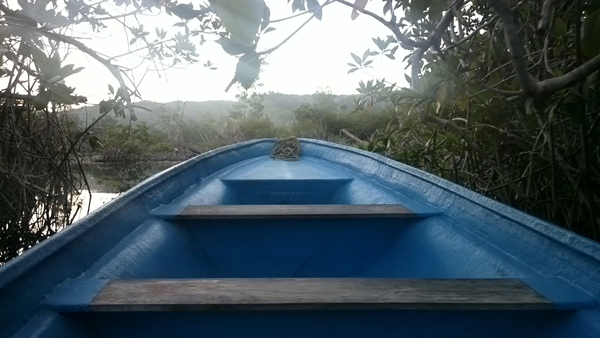
Se fueron los pájaros is a piece that originates in landscape, language, and idleness. At the invitation of a group of fishermen from Isla Pájaros, Quintana Roo, the composer Carlos Sandoval spent a period making a visual and sonic record of the surroundings. The raw sonic material opened the possibility of incorporating subtitles for the deaf — Sandoval had previously been "collecting" the disability subtitles from the TV series Breaking Bad — giving shape to an anti-soundscape, in the composer's words: "the reconciliation of impossibles." Se fueron los pájaros is a video that probes the mutant and evolutionary potential of language.
The nature of your work is particular because it articulates itself, in equal parts, from sound and image. Your original training is in musical composition — what limitations did you find in it that led you to look for other expressive tools?
In reality I am a reluctant composer. Before composition I had a lot of contact with painting — through my aunt, a printmaker and muralist — photography — through my maternal grandfather, a pioneer of color photography in Mexico — and cinema — through my mother, a hopeless addict. However, as the perpetual failure that I am, none of these disciplines grabbed me by the throat the way music did. I completely abandoned the visual to dedicate myself to studying — very late in my life — five years with Estrada, who incidentally taught me Cartesian graphing techniques, the ideal link, according to Mr. Xenakis, between the visual and the sonic. Estrada also introduced me to the exceedingly boring techniques of staring at yourself in perpetuity and thinking that the universe resides precisely there, in the Freudian filth of our acoustic black hole, the navel. Anyway, everything came together like the perfect storm of non-ideal situations that served to get me lost, like the Little Prince, on a small planet without borders, channels, rules, without rivers or roads. Decades later, the digitization of the analogue has allowed me to recover the visual from experience, since all my notes and observations are digitized and subsequently observed outside the context of sublimation, perception, or introspection. This allows me to juggle arbitrarily with materials and adapt them at will to create a work that surprises me. Because that is what keeps me optimistic: seeing how from nothing an oar comes out of the water at the same moment that a fish dies of old age. The automation implied by writing a score in the corner of my table for a musician in the corner of his life, to play it in the corner of the program, in the big theater on the corner — not for me.
I am interested in knowing more about your working method. In Se fueron los pájaros, a piece you have just premiered, you develop a video from a "spontaneous invitation" from some peasants in Quintana Roo. That is, there was no prior plan for the piece. How does it then become a reflection, not only on deafness, but on visuality and sensory crossover?
Se fueron los pájaros is a good example of the cynicism that, with so much effort, I have managed to develop. The invitation from these former fishermen was indeed "spontaneous" on their part — I suppose — but my acceptance of their invitation was not. I believe in an irremediable connection between things, in a synthetic macro-synapse, and I do not believe in spontaneity — which implies disconnection, and is therefore usually stupid. Se fueron los pájaros has two main origins: the first is the collection I made some time ago of all the captions for the deaf that I managed to gather from almost all the seasons of Breaking Bad. Not the subtitles but the brief descriptions of sound as they occur in the film, for the disabled. That list of sonic descriptions was saved somewhere on one of my hard drives. I don't even know why I made it — perhaps simply because I could. The other origin of Se fueron… is this East German spy vocation I have. I am good at recording people without their noticing — that is, at turning experience into documentary. Listening to the recording of the former fishermen dry, months later, the connection between Breaking Bad and Isla Pájaros was made. I made a first sketch of the video to see how the captions would work, without plot and without image. Then I decided to use another video I made in Ventanilla, Oaxaca, in which you see, from a navigator's eye, the prow of a small blue boat moving, almost floating, through a mangrove. It took me almost two months, a few hours each day, to insert the captions into the video after analyzing the audio. A madness, second by second. The result is a kind of false documentary, an anti-soundscape, a road movie without music, a migration toward frustrated desire, a video-cocaine for the deaf who hear — and perhaps one of the first soundscapes for the deaf made in my neighborhood.
The question could extend to your work as a whole: it is difficult to find common threads between your pieces, as if you jump freely from one idea to another. What is the reason for this?
Yes, the lack of channeling or focus can even be seen as a problem. I am not the one to say, but I think there are more connections between each Anti-Lego of my work than it appears. But it is true: I avoid style. For me style is just a thin slice of stale ham between our idea of "freedom" and our own limitations. An important piece for understanding this is Die basta Zeiten sind vorbei: the piece is generated through the dilution of its materials. And only through repeated performances could the minimal seminal materials be identified, in a kind of rational contemplation deferred in time. Normally a single piece could represent the microcosm, the worldview, or the "aesthetic orientation" of a composer — take Bach and bow. In my humble case, it would be necessary to listen to and see many of my pieces to only understand that I actually have many ways of seeing and hearing the world, and that I try to be consistent with each one of them. The one who takes responsibility for this vision is me: my pieces do not represent me, I represent them. What unites my pieces is a disguised curiosity about how certain perceptible elements that normally ignore each other sometimes end up meeting on purpose, without their knowing it.
In addition to sonic design, improvisation, or classical composition, you have defined your work from the terrain of "sonic speculation." Could you elaborate on this definition?
The speculator gives a quantifiable value to the abstract relationship between things. It is the same thing. There was a period when I made "improvised" music — I put it in quotes because for me improvisation does not exist — with my sensor gloves. I had banks of sounds organized into acoustic families, and software that picked them up "at random" — like those claw machines in arcade windows, that give you a chance to grab stuffed animals, if you can. I used these sound families to speculate not with chance, which is exceedingly boring, but with that incense mysticism "inherent" to improvised music, where things work — or not — through "magic," through "vibes," through "connection with the audience," "between the musicians," and other such niceties. I can say only one thing: the gloves and the software always adapted, as if they were alive, to the music I was making at that moment. I cannot explain it. It is speculation seen as magic de-ritualized by experience — this could be a definition of my work over all these years.
From 1991 to 1994 you worked for Conlon Nancarrow, one of the most singular musical minds of the twentieth century. What would you say were the main lessons of that encounter?
Like Xenakis, Nancarrow is a Cartesian composer who believes in objects precisely because they are musical. As a consequence — and the link is not gratuitous, in my context — Nancarrow is also visual in his rolls. Conlon, however, gives a more phenomenological dimension to his crude, pianola-esque tracings: I would call this dimension "the perception of time through motivic speculation" — that is, "the potential recognition of patterns despite time." Or: "if you hide the motifs from me I won't be able to see them," in plain language. In short, his work is also about macro-synapse — about making or not making pattern connections inside his Time Tunnel. As you can see, the influence is clear, and the assimilation of this influence, unconscious. There is nothing more Mexican, besides, than a dizzy perception of time and things — and I have Mexico lodged in my bones, no way around it.