There is a law in Mexico protecting the National Anthem. One of its articles states that it must be performed following the official score. Every Monday morning, across the country, millions of Mexican children, me among them, as I remember, violate it — with complete conviction.
What we produced, and they still produce, is not the anthem and not its absence. It is a turbulence of frequencies with a single direction — not a melody, but the shape one leaves behind. Every singer holds the complete melody in their mind and sings it with the certainty of someone doing it right. What fails is not the model but the body's capacity to reproduce it. Multiplied across hundreds of voices, that gap becomes the material — not a defect, but a constant. The residue is the music.
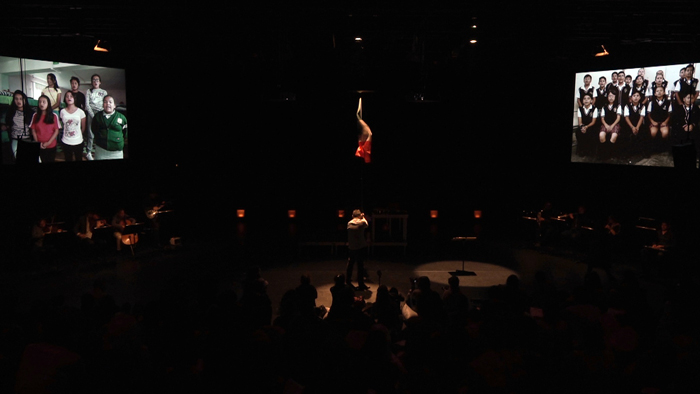
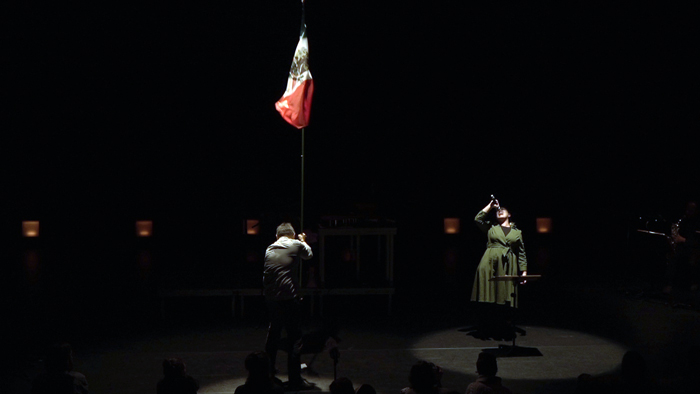
The stage replicates the elementary school flag ceremony. A woman marches on with a large flag. The conductor receives the flag and uses it as a metronome — a full-body baton for eight musicians aligned at the back of the stage. In darkness, a spotlight on the flag.
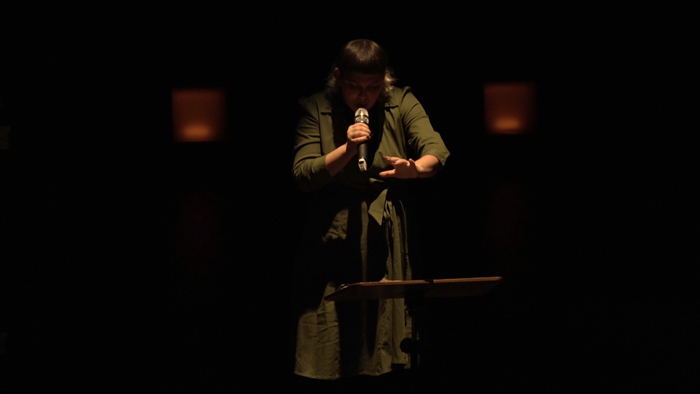
The eight musicians play the military drum rhythms that always accompany the anthem — the official skeleton. The pitches they assign are entirely their own, Ad Lib: eight simultaneous tendencies, none of them the score. On two large screens, documentary footage of Mexican schoolchildren singing exactly as I remember — attuned to nothing but each other. A solo soprano begins as a child, inside the collective memory, and gradually moves into the improvised language of a trained singer — the technique that grew out of the turbulence without ever fully leaving it.
What I absorbed before I had any theory of pitch became the ground of my music — not a compositional decision but a terruño, a native soil. This piece is where I found that out.
This is Social-Acoustic Tuning as an Attractor system operating at the scale of an entire culture. No fixed intervallic structure governs what the children sing — and yet the result is not chaos. It converges. Hundreds of voices, each holding the complete melody in their own body, produce a collective acoustic field whose direction is shared and whose pitch is distributed. Some cultures formalize this coordination into explicit modal systems — Persian classical music, ancient Mesopotamian and Indus Valley traditions, Chinese and Japanese imperial court music. Others never do. They simply inhabit the field they have always lived inside. The ear that cannot reproduce a tempered pitch may not be hearing one in the first place. They sing what they hear. The listening question runs underneath all of it: if the execution diverges consistently across an entire culture, the divergence may not be in the singing but in the hearing.