Schwebezustand, trembling suspension, is a perceptual and ontological condition in which an object or being simultaneously inhabits more than one state of existence without resolving into either, and without abandoning what it is, primordially. It is the simultaneous perception of an entity under two determinations that do not cancel each other, a contact, without directrix, without destination, without intention.
Schwebezustand carries other connotations prior to its integration into this essay. In German law, it defines a legal matter in which both parties carry equal argumentative weight until it is resolved. In physics, a body reaches Schwebezustand when it neither sinks nor floats, suspended in an exact equilibrium of forces. In political language, a nation's status can remain in Schwebezustand for years. My connotation, then, is not foreign: it is one more field in which the same principle holds: two unresolved conditions, in which the weight is shared equally. This is not mere etymology. Coinciding with what Reinhart Koselleck called Begriffsgeschichte (the way a concept accumulates layered, coherent meanings across contexts, without losing its internal logic), I extend the connotation of the word to another field.
Artistic expression does not generate a Schwebezustand by itself. However, without formal artistic coherence, it remains only as perception, as anecdote or curiosity. Art is the operation that makes the condition legible: it does not create Schwebezustand. It creates the conditions under which Schwebezustand can be perceived, sustained, and examined, because it gives duration, form, and necessity to the simultaneity already present. The condition precedes the work. It is discovered, not invented a priori. Art only makes it impossible to look away.
Schwebezustand sustains itself atemporally; it is not linear. As an entity of double existence, it does not "happen," it does not "resolve," nor does it "become." An attentive reader might perceive a Schwebezustand and try, almost intuitively, to relate it to concepts such as "ambiguity," "metaphor," "metamorphosis," or a "middle point." But these four concepts are something else:
It is not ambiguity. This term implies instability: something that wavers, weakening, refusing to settle. It is an "undecided" condition. Schwebezustand, for its part, is a perception that vibrates between two states that hold, at once, the same ontological weight.
It is not a metaphor, which is a simple transfer of semes, as in "...in the clear hip of the coast...". Neruda, its author, gives the coast a body. The reader, in turn, perceives both, but neither one becomes its counterpart, because a metaphor, as I said, consists of a permutation of meanings. In a metaphor the question would be "what else can something MEAN," while in Schwebezustand the question is what else can something BE.
Nor is it a "middle point." Unlike "liminal space," "border," or "in-between" (concepts that imply transit, negotiation, or direction), Schwebezustand is perceived within an entity, in its own existence, without direction and without destination. One is not standing at the border, or in the threshold between the living room and the dining room at home; one perceives a trembling entity that lives between these two spaces, without this implying that they lose their identity.
Nor is it a metamorphosis. The caterpillar (A) becomes the butterfly (B). The process has direction because B is already determined before the transformation begins. If B is removed, there is no "interrupted metamorphosis." There is no metamorphosis at all. Metamorphosis is defined by its destination, not by its movement. A transformation stuck between A and an unknown B is not a "paused metamorphosis," because the stuck condition is not even a chrysalis — it is perhaps a semi-seed, a dry leaf, a capsule that announces neither what it contains, nor whether it contains anything at all. Schwebezustand is nonexistent.
What becomes of a being, ontologically, when two perceptible determinations simultaneously become present within it, without one replacing the other? In the case of Metamorphosis, for example, A becomes B. In the case of Schwebezustand, A remains A, while B is also perceptible, and this perception trembles between both, within a third entity.
Accomplices
The condition is ancient. Across many geographies and many centuries we see it in the Yoruba Egungun mask, worn by a dancer who becomes, literally and ritually, the ancestor, while remaining himself; in the Sufi sema, where the whirling body is simultaneously physical dance and spiritual ascent; in the Mexica Coatlicue, standing between therianthropism and anthropomorphism, between architecture and sculpture, between symmetry and doubling; also in the Nahua tonal, where an animal accompanies a person's fate from birth, still visible today in indigenous communities across Mexico and Guatemala; and in the recited Buddhist Heart Sutra. These radically different cosmologies and philosophies produced situations in which a being could not be limited to a single, self-contained identity. There is no need to posit a transmission between cultures to recognize the recurrence of this condition. They are examples in which the condition becomes visible. Western phenomenology — Husserl, Heidegger, Merleau-Ponty — arrived later, and from another place, at a similar intuition, but as seminar theory, not as lived practice: the distance between them says as much as the resemblance.
But let the cultures speak for themselves. Most likely, the reader will find it easier to approach them than for these cultures to "travel" toward the reader, before any academic display that might be imposed on them. In Mignolo's terms, this is called the "geopolitics of knowledge": the power to decide what counts as knowledge — and who is allowed to produce it — has never been shared equally.
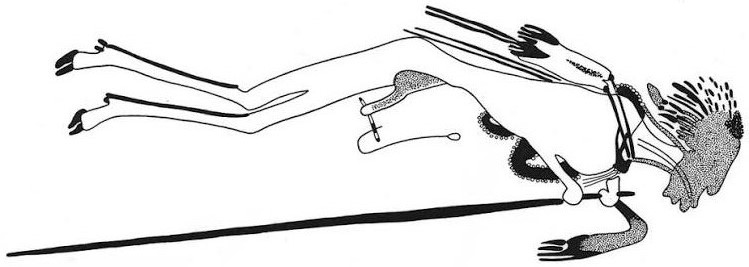
THERIANTHROPIC FIGURE, ROCK ART
What I describe here is a field of ancient cosmovisions that attract one another: societies without coordination, independently producing comparable structures of thought around multiple or relational existence, double existence treated as a condition of existence, without needing any forced external cohesion. But the center does not exist because there was never a destination. Each tradition arrives on its own terms, with its own vocabulary, its own cosmology, its own impulses. If any convergence exists, it belongs to the condition itself, not to its definitions.
In these traditions, the self is constituted through its interrelations, being is multiple, existence is shared before it is individual. From that ground, simultaneity is not a problem to be solved — it is, simply, a way of seeing reality.
Hegel, for his part, would place German philosophy at the center: Spirit reaching its "self-consciousness" first among the Germanic peoples. And "the Orient" and the African continent dismissed as what he called "the childhood of the world." That destination, Hegel assumed, could be reached only by "the West." There are those who still try to save — believe it or not, reader — this Hegelian architecture: they renounce its foundations but keep its notions of freedom, half-heartedly abandoning its principles of hierarchy. That Hegelian architecture, however, did not come from nowhere: the earlier philosophical tradition, which includes Descartes, Locke, and Kant (contemporary but no accomplice of Hegel's), each in his own way, placed the individual as the primary unit of reality: a whole self prior to its relations, a self that exists first and only afterward relates. Charles Taylor wrote the long history of how the modern self came to be understood this way. I don't need the whole story — its consequences are enough: an entity with two simultaneous existences can only be paradoxical, contradictory, or metaphorical.
At the same time, the vast European scientific tradition that produced Newton and Einstein beat rapidly, with a marathon-like pulsion chasing the search for general laws capable of describing reality through a single, universally applicable framework: a Cartesian pulsion, dragging itself like cordial tanks, like a game of Lego, on the colonial table. That same impulse — reality reduced to what a single vision can administer — is the one that, applied to other peoples' cosmologies, ended up calling them "primitive," "superstitious," or "incomplete," because they could not be resolved within the norms of mono-existence. Aníbal Quijano named this operation the "coloniality of power." It may not have been only contempt: it may be that they truly could not see another way of existing — what Boaventura de Sousa Santos calls "epistemicide," a monopoly so complete it forgets it is one. Einstein himself accepted the extraordinary success of quantum mechanics and its statistical formalism, but rejected the claim that its indeterminacy constituted a complete account of physical reality: with Podolsky and Rosen, in 1935, he argued that, if their notion of physical reality was accepted, the description provided by Ψ (the central mathematical object of quantum theory: the function describing the full state of a physical system — an electron, for example) was incomplete. In Einstein's reading, this unresolved matter pointed to an inconclusive theory, not to an unresolved reality.
Examples of Schwebezustand (Trembling Suspension)
In this group of pieces (used as examples) Trembling Suspension revealed itself clearly to me for the first time; they are not a collection of evidence assembled to support a theory; they are the ground the theory was extracted from. In some, both perceived trembling entities are intrinsic ontologies: equally verifiable, they need no interpretation, they belong to the thing itself. In others, one entity is intrinsic and the second is relational: it does not belong to the object on its own, but arises because the viewer infers it or provokes it. And in the last one, the nocturnal drawing series related to what I call Dog Visions, the suspension lived only in the act of making it; the finished object does not conserve it.
Example one: Mach
Ernst Mach drew himself from the left eye in 1886. The upper arc at the top of the drawing is the real frontier of his own existence: beyond that arc stands the viewer, a relational condition that exists only where someone is standing. And this is a trembling condition, between the viewer and the drawing.
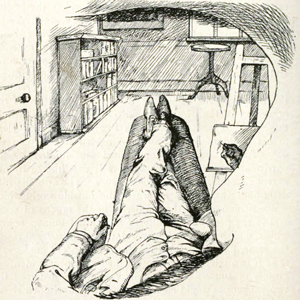
ERNST MACH, THE GRAMMAR OF SCIENCE, 1900
Example two: Van Gogh, Kahlo, Bacon
A Surfaced Trembling Suspension, as I have decided to call it, is a tremor absorbed by markets and repetition, made louder than the work alone would produce, if it produces anything at all. Galleries, museums, and the mainstream art market know that drama sells: severed ears (Gogh), asylums (Gogh), shattered vertebrae (Kahlo), violent parents (Bacon), infidelities (Kahlo), suicides or murders (Gogh), extreme poverty (Gogh), repeated in wall texts, documentaries, gift-shop books, until the story installs itself in the exhibition room before the viewer does. What is added is volume, but also drama and emotional pornography. "Pornography" comes from the Greek pornográphos, to depict what is sold. The market does not invent an artist's drama; it makes it surface, waters it, and sells it. My description is pure mechanics.
About his painting, Van Gogh wrote to his brother: "On the terrace there are tiny figures of drinkers. [...] The gables of the houses on a street that leads away under the blue sky studded with stars are dark blue or violet, with a green tree." He names shapes and colors — figures, gables, blue, violet, green — nothing more. No identity, no story.
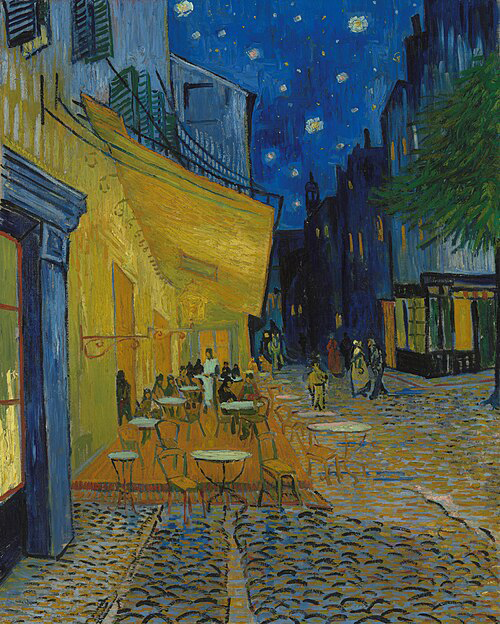
VINCENT VAN GOGH, TERRASSE DU CAFÉ LE SOIR, 1888.
But the art market also handles neurotic concepts like this: identity, narrative, drama, and symbol, all built on the same surface: "In white, Jesus stands at the center, long hair, surrounded by the Twelve apostles. The obscure presence in the doorway should be Judas, and the lantern is a halo. Crosses everywhere: in the awning, in the street, and far away, almost imperceptible, a suffering horse. The left side is happiness, the right is sadness. The empty chairs are the empty past."
This is a surfaced trembling suspension. A trembling suspension, as we have already defined it, consists of simultaneous conditions inherent in the encounter with the work or object. Surfaced, in contrast, is a pre-existing perceptual condition in which an abstract perceptual layer surfaces thanks to external narratives.
Example three: Found object
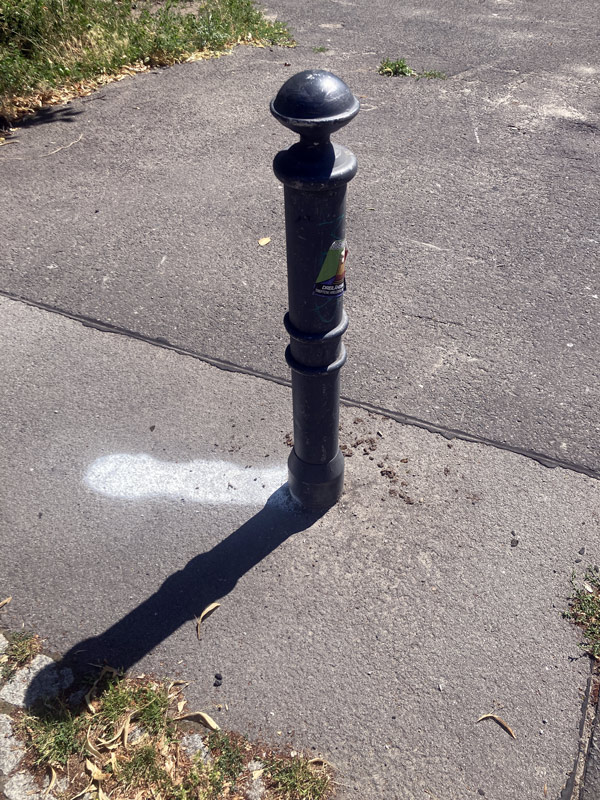
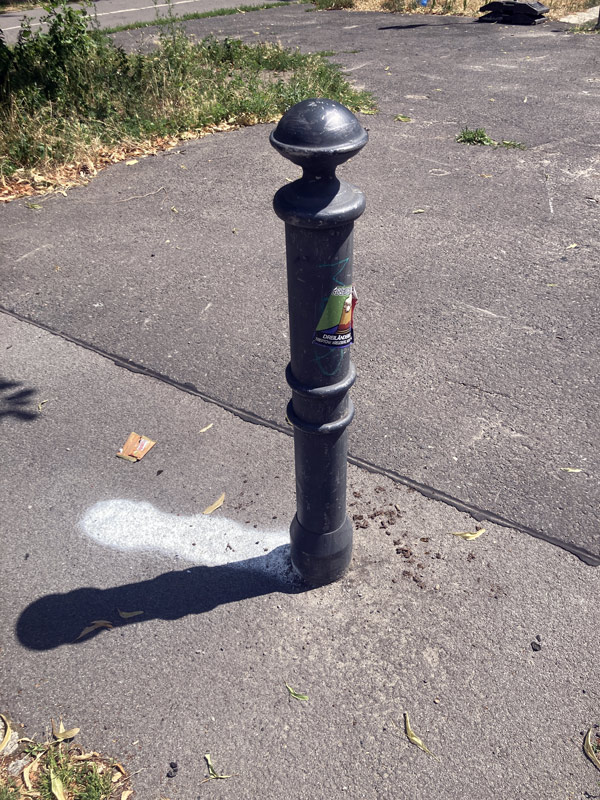
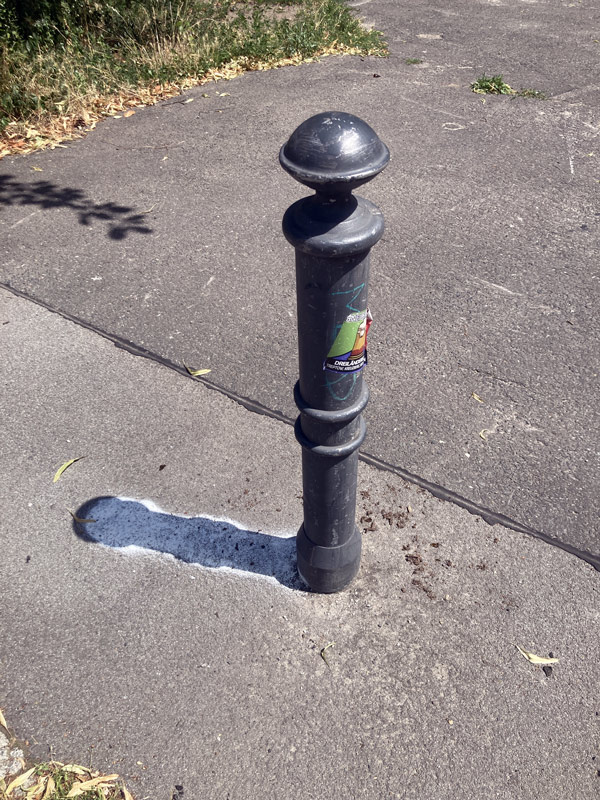
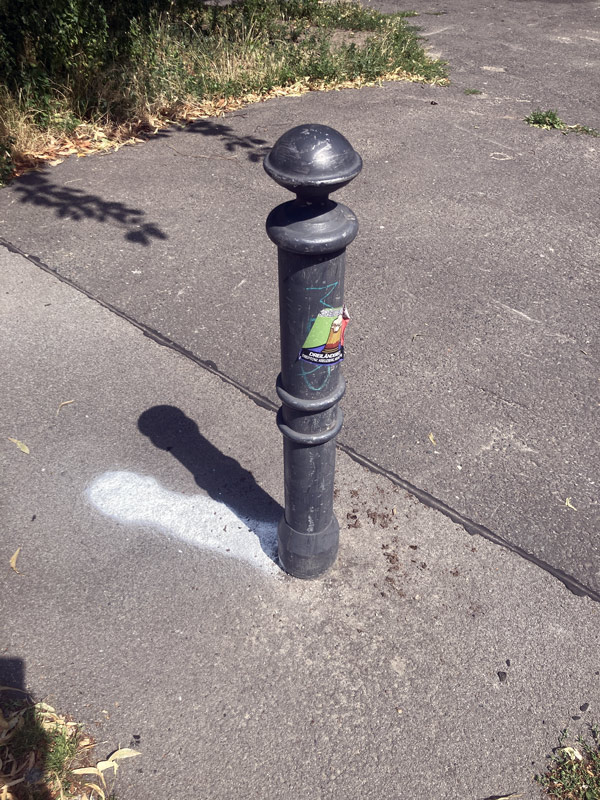
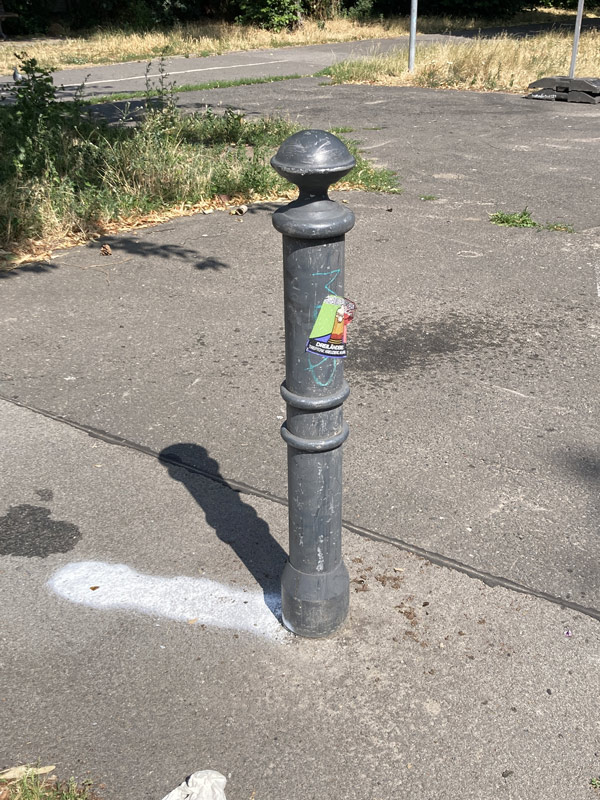
FOUND PIECE, BERLIN KREUZBERG, 2026.
I come across a bollard, one of the thousands in this city. This one, however, carries a history written both with spray paint and with photons. Its shadow has been traced over, and with this tracing the passage of time has been honored, or, if that sounds too abstract, the cosmos has been honored.
I took one photo every hour for five hours with no premeditated reason, as I always do, but after seeing the photos the conscious connection emerged: "this is an object similar to my Mandarino Marioneta and my Huge Mobiles, but more complete," I thought. And yes, its "modest" dimensions reach Giza, Palenque, Chichén Itzá, Xochicalco, Chankillo, observatories, temples to curiosity for autistic observers in search of perennial coherences.
I adopt it now to go deeper into a Trembling Suspension of four simultaneous existences — two is the minimum for the condition to hold, not a ceiling — a bollard, a sundial, an observatory, street art, shadow turned into light, which, at the same time, turns the bollard into shadow. Each condition, intrinsic, physically present, demanding no interpretation whatsoever. It is a found object, perfect, gentle, all-encompassing. I had Claude find out, feeding it numbers and measurements, when the paint was actually sprayed. It was possible to find out: four days after the summer solstice.
Example four: Huge Mobiles
Two petroleum barrels (a standard unit of measure in the oil industry, and a common object on construction sites) contain steel rods suspended from their top cover. After a single push, the rods collapse against each other, like a bamboo mobile. The barrels sound by themselves, for a prolonged time, by weight alone. There is no mechanism, no intervention, no wind. An industrial object that produces sound through the most impersonal and mysterious physical force that exists can be perceived as a sounding entity, both conditions intrinsic and clearly verifiable. Neither condition cancels the other; the barrels occupy both simultaneously, without resolving. This is a "mother cell" piece in my catalogue: it was the first occasion on which trembling suspension intuitively manifested itself, before being named. A work in which the perceptual condition appears in its most reduced and unmistakable form.

HUGE MOBILES, TEMIXCO, 1987. PROMPTEDAnalogue F1, color, 35mm, C45, 50mm, f5.6 Temixco, Mexico. A typical low class suburban house, low class, not finished but occupied. Around 16:00. The sun to the left. Photographer seated. The garden was a garden, but now different local plants grow. Two old oil barrels under a tree, with suspended construction rods inside. Prompted reconstruction; no documentation available., NO DOCUMENTATION AVAILABLE.
Example five: Mandarino Marioneta
The same absence of wind appeared much later. A young, living mandarin tree is manipulated with a black thread invisible to the camera. When the thread is pulled, the tree moves, evoking the movements caused by wind. Trees, however, are not "marionettes of the wind": they are simply trees that move because of wind. In the video, someone invisible moves this mandarin tree from behind the camera. Without compromising even a bit of its ontology as a tree, it adds the ontology of a marionette. Unlike the barrels, the two conditions here are not both intrinsic: the tree is; the marionette is relational — it exists only because a hand pulls a thread the camera cannot see, and only because the viewer infers, from that motion, a puppeteer. There is no detriment to either condition from this asymmetry. Both remain fully present, one given, the other legible through intervention. This is also a mother cell, the same logic as in Huge Mobiles.
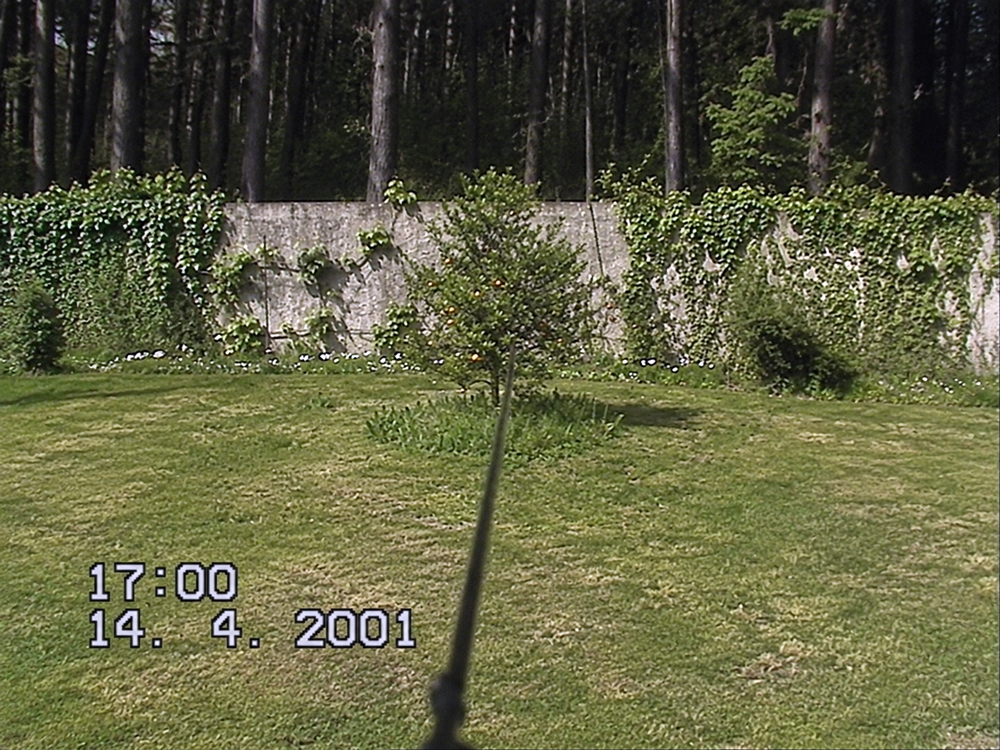
SANDOVAL, MANDARINO-MARIONETA, HUITZILAC, 2001 (PROMPTEDCanon, MiniDV from 2001, small camera, handheld, 4:3. Cropped, 90 degree corners, not curved corners. Midday. Video texture. Garden, outside, ca 17:00. Small citrus, kumquat tree about 1.5 meter high, with some fruits visible. The tree about 6 meter away from the camera. Well maintained garden, but not perfect. The tree has a tree ring, with small wild plants in there chaotic, also a bit grass around. The grass in the garden is not homogeneous, different tone of green and yellows. One branch right side of the tree is in gentle movement, but not the rest. The moving branch has to be part of the tree, not distant. You can see the leaves, but a bit movement-blurred, not so much. The camera guy, apart from holding the camera, is pulling the tree with one thin black sewing thread. The geometry of the thread: departs from the center of the frame, taped on the camera lens, very out of focus because it is too near, a bit focus later, to disappear near the tree. No parts of the body of the camera man is visible. Behind, a wall covered with cement and some plants. Behind the wall 2 or 3 huge cold-forest trees, and behind them, more trees like them, in the shadow.; NO DOCUMENTATION AVAILABLE)
Example six: My dog in fatal metamorphosis
My dog lives entirely in the present. She does not know she is within a fatal metamorphosis — not because she is unaware of her final destiny B, but because her mode of existence does not include B as a known category. She is within an absolute A: present time. She is not in a process. She is in a condition. And yet I perceive her in both dimensions: the A she inhabits completely, and the B, her death, which she will reach without knowing it. We have then two perceived simultaneous existences: me, a metamorphosis, and her, just the present. But Trembling Suspension lives in me, not in her. Even if she fully perceives me in Present Time, she remains, fully and solely, in Present Time. It is my perception that trembles between what she is and what she does not know she will become. A suspension that arises just in that tiny, delicate relation between an entity and whoever perceives it, a relational condition that belongs to me, not to her.

C.S: ABBA THE TIGER. BERLIN, 2022
Example seven: Tent Visions Series
(2025). Ink drawings made at night, in the forest. I follow the gaze of my dog closely, her gestures of attention, her doubtful sharpness at the edge of attack. I draw a real tree at night, and behind it I draw what I think my dog sees. While drawing, I am between the two: in a trembling, relational suspension that disappears the next morning, the drawing does not hold it, it blurs, it fades like the dew in the early morning of the landscape.
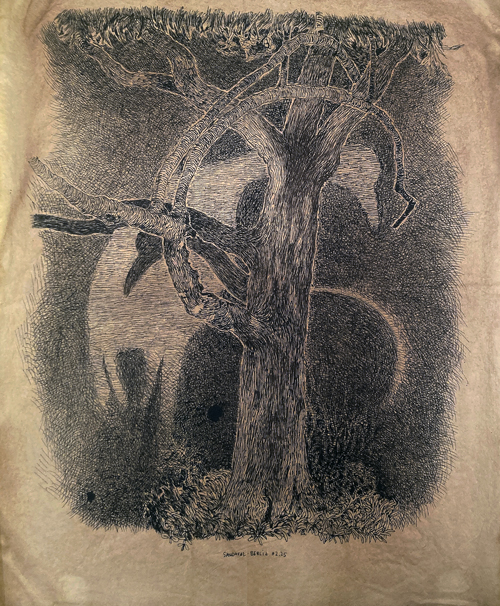
TENT VISIONS 08, 2025
Example eight: Monas
(2025). An automaton built with simple mechanics (off-center components, irregular cams, sensitive materials) that captures exactly what a perfect mechanism was designed to eliminate: hesitation, vulnerability. Perception is lost between the mechanism intrinsic to the object, the machine, and the "living organism" (relational perception).
Example nine: Máquina Latina
(2013). A live pianist performs before an audience while, on screen, the same performer is shown on video, in the same attire, performing similar actions and conveying similar pathos, in real time. Neither is more real than the other; the audience finds itself in trembling suspension between both.
Example ten: The Body of Ligia
(2007–2020). The dancer is simultaneously a body, a sonic cartography, an instrument, and a dancer. None of these conditions cancel the others — four simultaneous conditions coexisting without hierarchy, all four intrinsic to the body itself. Ligia's bestial nudity struggles for attention, and that too is another form of simultaneous existence, putting the audience in trembling suspension.
Certainly there are specific conditions defining Trembling Suspension: both conditions, A and B, remain present; neither condition is symbolic of the other; there are no passages between them; neither condition awaits resolution or is provisional; and the entity does not cease to be what it primarily is. These are the conditions under which I recognize Trembling Suspension.
The Morocoy grave, with its tombstone illegibly traced by a finger into wet cement — a failed certificate of existence — represents a failed intention of describing the life of a dead person. (Tombstones usually tell us the story of someone who no longer exists, but who, at the same time, lies beneath our feet). Here, that trembling suspension is intrinsic, and doubly indeterminate: we do not know what lies below — human, dog, discarded trash — any more than we know what the writing says. Two existences of the same entity share equal ontological weight; its illegible description and a supposed existence of something under us, both vibrating between each other, without resolving. The illegible handwriting is not only an element of that suspension, but also makes us perceive a "lost soul" in immense solitude. Perceiving the grave this way means not granting its context automatic authority: a hierarchical perception would assume that, because this lies within a cemetery, there MUST be a human corpse below, or that the illegible text SPEAKS, specifically, of that corpse. Non-hierarchical perception does not automatically grant the context that authority; it looks without ranking, and it is usually in that flattening where the unsuspected appears. "Lost Soul" is an ontology I will develop in a coming essay. Unlike Trembling Suspension, it has not yet crystallized into any work: it is what a non-hierarchical perception allows me to see, directly, before it becomes a piece.
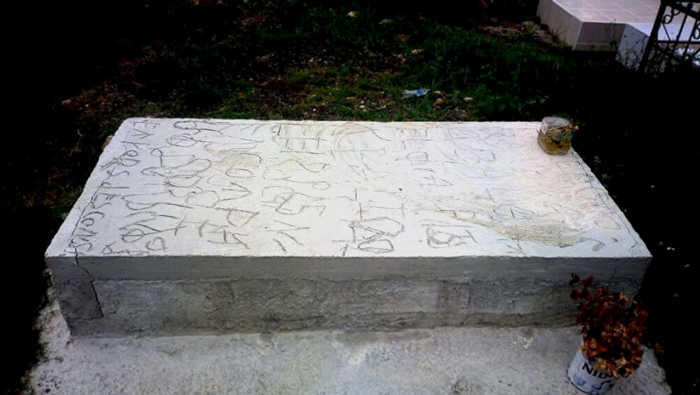
C.S: CEMETERY OF MOROCOY, SOUTH QUINTANA ROO, MEXICO