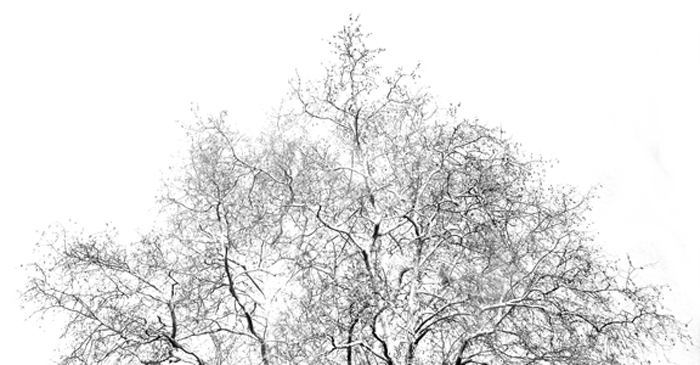
Selected branches are fitted with accelerometers. When the wind moves a branch, the sensor transmits a sequence of numerical values to the software — light, continuous, purely physical data. The software reads those values and triggers sounds from organized banks and clusters, picked at random within the parameters I set. The sounds are arbitrary: I decide which sonic world each tree inhabits. The wind decides when and how much. This is sonification in its purest form — physical data translated into artistic interpretation, with no natural correspondence between the two. The tree doesn't know what it sounds like. I do. The wind doesn't care.
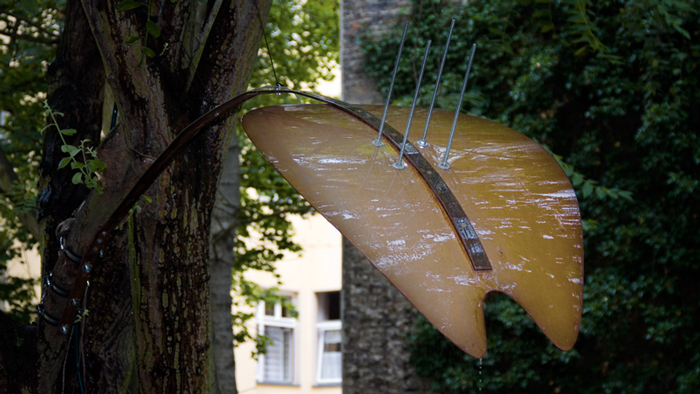
Each tree carries its own sonic character: glass-like chimes, human whispers, piano notes, percussion, electronic textures. Leaf-shaped speakers hanging from the branches release those sounds into the air around them, blending with the canopy. The tree performs its own weather.
The network is what makes this more than a local installation. Trees in Berlin, San Luis Potosí, and Florence were connected in real time — live movement data travelling across the globe during performances. A tree in Mexico could echo the gestures of a tree in Germany while keeping its own sonic identity. A windmill network compensates for absence — redistributes energy to maintain output. This network did something different: absence of wind at one node was not silence but an invitation. The tree borrowed another tree's wind and kept producing. The field was always active somewhere. It never fully stopped.
Years later I would draw mycelia series in ink — the fungal networks that spread through forest soil without direction, no origin, no destination, the same logic of distributed presence without a center. The connection was already here, running through fiber optic cables, before I knew what to call it. Field Logic at continental scale: local sensors, distributed nodes, global coordination, no single point of control. The forest thinks across borders.
Trees with Sensors was a completed body of work, developed between 2005 and 2014. Sonification as a technique — and the aesthetic it produces — belongs to that period. The work is done. What it figured out is still running.