This text is a modest attempt to answer questions I ask myself daily: What am I doing? What is this? How does it work? How does it relate to everything else? Not a theory arrived at in advance. A cartography drawn after the fact — perhaps because of my age, perhaps because new projects demand it. At the end, a short list of works that, to my mind, fit.
I. Definition
The Threshold is a perceptual and ontological condition in which an object or being simultaneously inhabits more than one state of existence without resolving into either, and without abandoning what it primarily is. Unlike ambiguity, which implies instability or weakness of meaning, the Threshold describes a condition of density: two or more states coexist within the same entity with equal ontological weight, neither canceling the other nor producing a third, hybrid term. Unlike “liminal space”, “border”, or “in-between” — concepts that imply transit, negotiation, or passage from one condition to another — the Threshold requires no displacement. The Threshold is the result of a perceived (and formally resolved) potential for simultaneous existences. It is not a transmutation, it is not a “non binary” identity. It occurs within an entity, in its own place, without passage and without destination.
A petroleum barrel — a standard unit of measure in the oil industry, and a common object on construction sites — contains steel rods suspended from its top cover. After a single pull, the rods collapse against each other — like a traditional bamboo mobile. The barrel sounds by itself, for a long time, from gravity alone. No mechanism, no intervention, no intention, no wind. An industrial object producing sound through the most impersonal physical force that exists, a being with duration. Neither condition cancels the other. The barrel does not waver between two meanings. It occupies both simultaneously, without resolving.
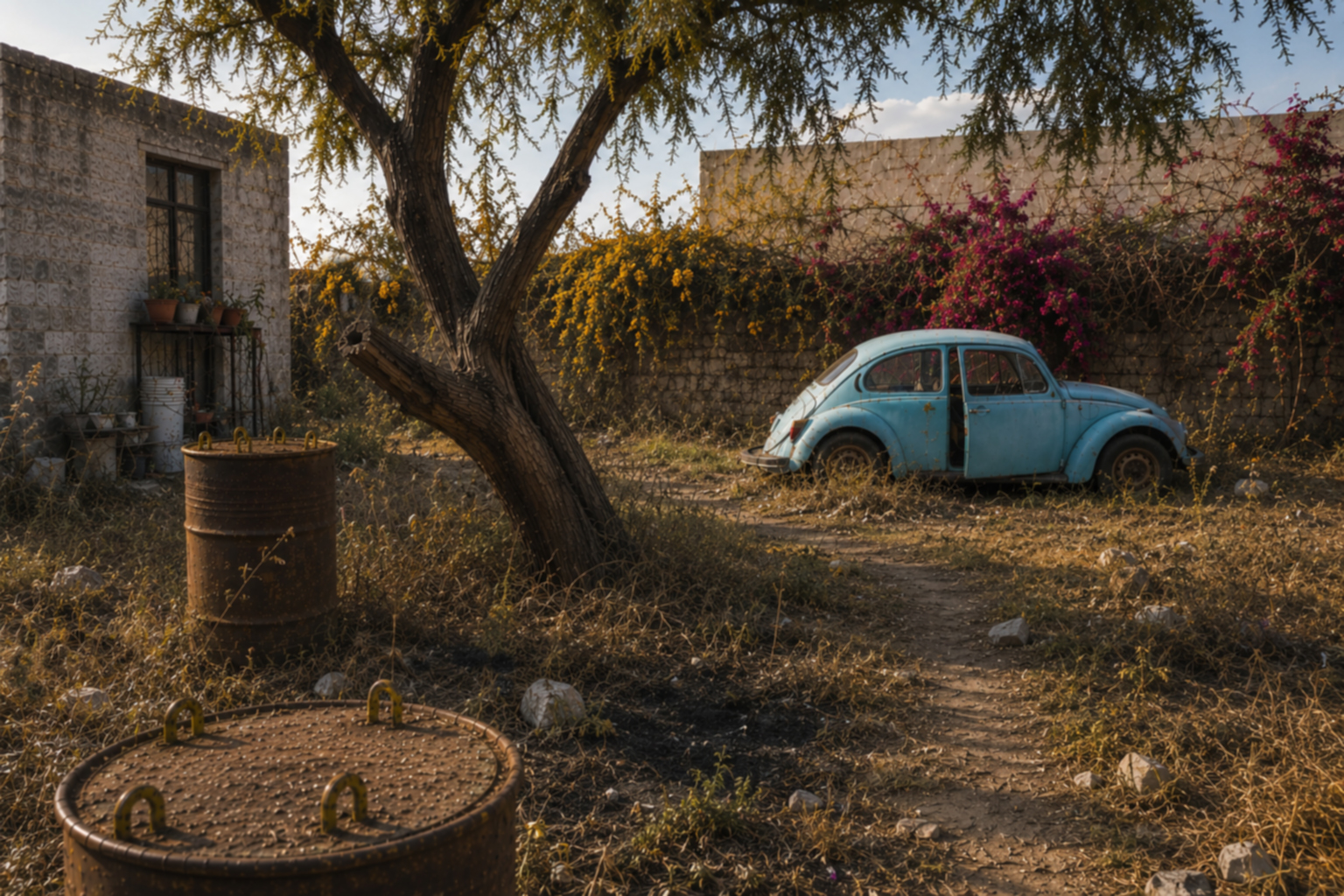
SANDOVAL, HEAVY MOBILES, TEMIXCO, 1987 (PROMPTEDAnalogue F1, color, 35mm, C45, 50mm, f5.6 Temixco, Mexico. A typical low class suburban house, low class, not finished but occupied. Around 16:00 The sun to the left. Photographer seated. The "garden" was a garden, but now different local plants grow, not more than 30cm, not less than 10mm. Some small yellow flowers. An old tree with character, perhaps a Guaje. Avoid repeated frequencies-patterns and geometries. The same for the plants on the floor, add chaos, history, accidents, the footstep of a small fire on the floor You don't see the tip of the tree, but you see the superior branch leaves falling into the frame. The trunk is curvy, dark. The tree had a difficult story. Along the tree there are two old, dark steel oil barrels, under the shadow of the tree. The barrelsare huge mobiles. They have varillas de construcción dobladas y colgadas en su interior, so the barrel is closed both sides, you see the some screws on top. they are the screws which holding the hanging varillas de construccion. In the background, left, a VW "bocho", light bue, in bad condition, parked. The door is slightly open, someone just arrived and took the photo perhaps. Behind the VW a stone wall, with an almost dying bugambilia.; NO DOCUMENTATION AVAILABLE)
The same absence of wind appeared, years later, in my garden in Mexico.
Mandarino-Marioneta is a living mandarin tree manipulated by thin black threads, invisible to the audience. When pulled, the tree moves exactly as it would move in wind. All trees are marionettes of the wind — but here there is no wind. There is someone invisible, moving the tree.
It remained a tree. And it became a marionette — a real one, with its operator behind the curtains. But the tree does not know it is a marionette. It is still a simple tree.
One is a living being. The other is an inert object. The Threshold does not discriminate.
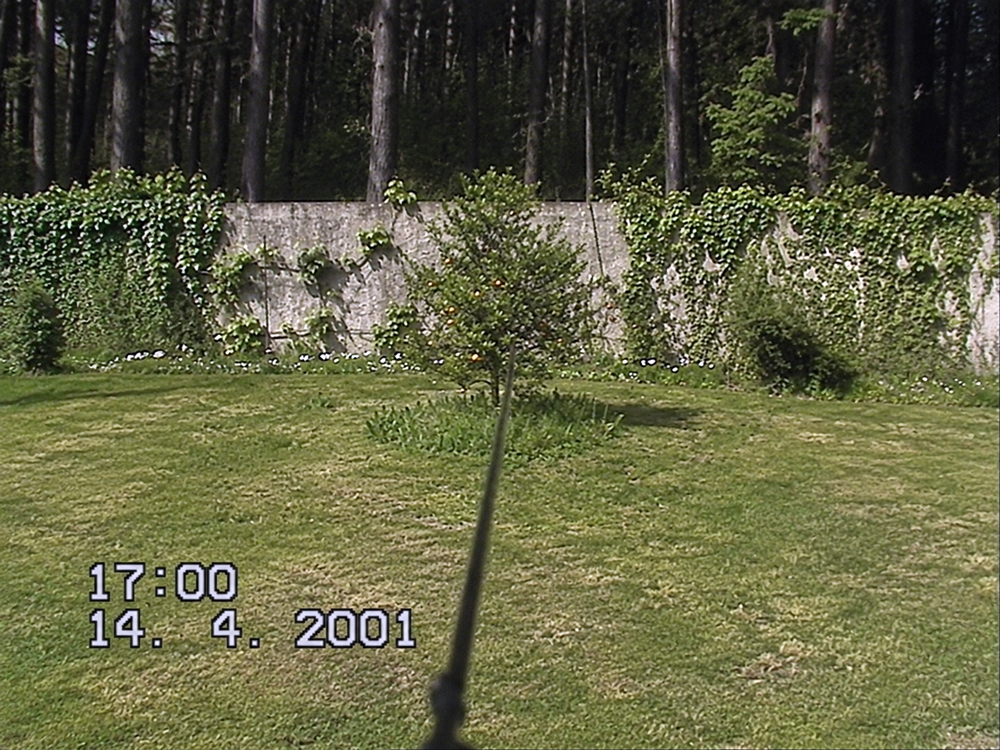
SANDOVAL, MANDARINO-MARIONETA, HUITZILAC, 2001 (PROMPTEDCanon, MiniDV from 2001, small camera, handheld, 4:3. Cropped, 90 degree corners, not curved corners. Midday. Video texture. Garden, outside, ca 17:00. Small citrus, kumquat tree about 1.5 meter high, with some fruits visible. The tree about 6 meter away from the camera. Well maintained garden, but not perfect. The tree has a tree ring, with small wild plants in there chaotic, also a bit grass around. The grass in the garden is not homogeneous, different tone of green and yellows. One branch right side of the tree is in gentle movement, but not the rest. The moving branch has to be part of the tree, not distant. You can see the leaves, but a bit movement-blurred, not so much. The camera guy, apart from holding the camera, is pulling the tree with one thin black sewing thread. The geometry of the thread: departs from the center of the frame, taped on the camera lens, very out of focus because it is too near, a bit focus later, to disappear near the tree. No parts of the body of the camera man is visible. Behind, a wall covered with cement and some plants. Behind the wall 2 or 3 huge cold-forest trees, and behind them, more trees like them, in the shadow.; NO DOCUMENTATION AVAILABLE)
The Threshold is not a method applied to objects and beings. It is a condition some objects and beings already possess — and that certain acts of attention can reveal. The Threshold is not produced by art alone, but without a coherent artistic form it remains only a perception, an anecdote, or a curiosity. Art is the operation that makes the condition legible: it gives duration, form, and necessity to the simultaneity already perceived. Two states of existence occupy the same being at the same time, without hierarchy, without resolution, without canceling each other.
II. Roots
The Threshold is not a spontaneous ontology. It comes from very far away, and from a long time ago. Across many geographies and many centuries — in the Nahua nahualli, in the Maya In Lak'ech, in the Mexica Teotl, in Sufi thought, in Yoruba cosmology, in Buddhist interdependence, in the Western phenomenological tradition — different cultures arrived, independently and without coordination, at the same recognition: that beings are not singular, that existence is relational, that what a thing is cannot be separated from what it is in relation to everything else. None of these traditions borrowed from the others. All of them were describing the same perception.
This is a field — elements without contact, without coordination, converging toward the same condition from different directions. I had already felt this before naming it: fields covered in mist, everything wet, including me. At dawn, still wet, I watched the mist rising toward its origin — like a lost soul that does not know where it is going. That experience became a concept, a field that has shaped my most recent work. These traditions operate the same way: no contact between them, no coordination, the same perception arriving independently from different directions. A field without a center.
I belong to the field of mist the same way I belong to these traditions: without that relation having a name, a title, a denomination, a definition.
Not every tradition arrived at the same place, though. The scientific tradition that produced Newton and Einstein pursued a different impulse: the search for a general law that would explain everything from outside, a single framework capable of rendering reality fully intelligible and administrable. That is the Cartesian impulse at full power. Einstein himself never accepted that indeterminacy or simultaneous conditions could be fundamental features of reality; for him, they signaled an incomplete description awaiting a deeper coherence.
Quantum mechanics found what the same project could not predict: that reality does not comply. Indeterminacy is not a technical problem pending resolution. It is the condition. The nahuallies (my name for those who intuit existence as relational and simultaneous) had been describing that condition for centuries — not as correction, but as a way to understand complexity intuitively, as an ontology of simultaneous existences. The Threshold is a modest part, among the others.
III. What It Is
Ernst Mach drew himself from the left eye in 1886. The arc on the right side of the drawing is the edge of his own visual field — his legs, the sofa, the floor, the window, the light outside, all seen from inside himself. Herr Mach is the landscape and the landscape is Herr Mach. The author is inside the work — not as portrait, not as signature, but as the eye that sees and is simultaneously seen.
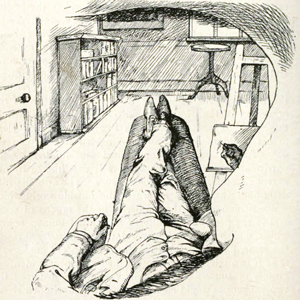
ERNST MACH, THE GRAMMAR OF SCIENCE, 1900
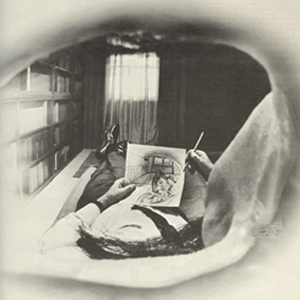
J. J. GIBSON, THE PERCEPTION OF THE VISUAL WORLD, 1950
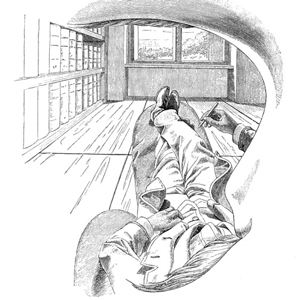
ERNST MACH, PICTURING THE VISUAL FIELD, 1886
And then something further: the arc that frames the drawing is not marked as his. Any eye produces that edge. The spectator looking at the drawing can occupy the same position without effort — and suddenly it is no longer Mach’s eye but their own. Two nested Thresholds: the author inside the work, and the spectator who enters without being invited. As we observe the Threshold, we become part of it.
Van Gogh is another example: he enters the sunflowers, the night sky, himself — each becomes a nervous system, a flame, a force that does not belong to botany or astronomy or portraiture. And yet, the artist remains entirely Van Gogh throughout his working life — the same pressure, the same temperature, unmistakable in every canvas. Not as style. As presence.
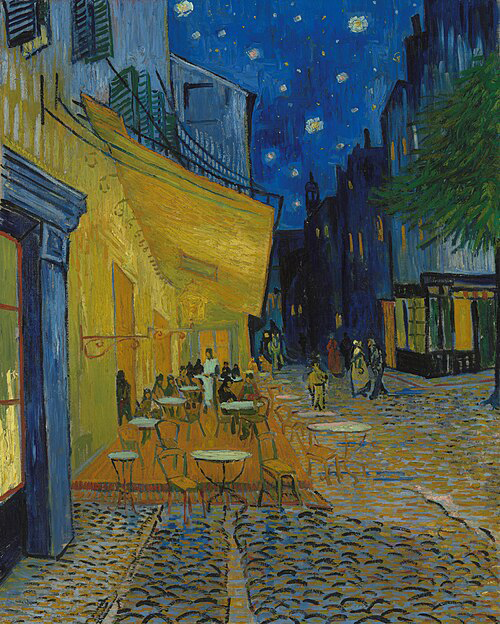
VAN GOGH, TERRASSE DU CAFÉ LE SOIR, 1888
At this point a question appears. Some readers will understand these examples as metaphors: the barrel acquires the qualities of a living being, the tree borrows the condition of the marionette, Van Gogh survives in the painting through a transfer of attributes. Modern theories of metaphor have long shown that meaning can emerge from the coexistence of different semantic fields. In this sense, the Threshold may appear metaphorical.
The resemblance is not accidental. Both metaphor and Threshold are poetic operations. Both resist the reduction of reality to a single condition. Both allow multiplicity to emerge where classification seeks stability. But they operate differently. Metaphor expands meaning. The Threshold expands existence.
The barrel does not merely signify agency; it acts. The tree is not only interpreted as a marionette; it is physically manipulated as one. Van Gogh is not represented through the painting; his presence becomes one of its conditions. What is at stake is not the coexistence of meanings but the coexistence of modes of existence. A metaphor asks what else a thing can mean. The Threshold asks what else a thing can be.
Picasso is a system — recognizable, inimitable, but as language. You can learn to speak Picasso. You cannot learn to be Van Gogh. What remains in Van Gogh is not technique. It is a being whose psychological complexity is permanent — not a style, not a perceptual capacity, nor an emotional dose, but existence inseparable from the paintings themselves. No hierarchy between the two. They form a whole. Schapiro read the brushstroke as the direct materialization of an interior state — pressure, temperature, direction inseparable from the one who produced them. The Threshold perspective points further: that presence is not a gesture, a color; it is part of the condition of the work itself.
But the spectator does not enter. We observe a Threshold. We are not part of it.
A new condition of the Threshold emerges here: the Threshold does not require a fixed relation between author and work. Mach is literally inside the drawing. Van Gogh is psychologically present in his landscapes — not visibly, but as pressure, as temperature, unmistakably. On the other hand, the barrel sounds by itself. The mandarin tree is the marionette of an unknown, invisible presence. In both, the author is absent — and it does not matter. The Threshold holds in all three cases.
IV. Catalogue in Context
Máquina Latina (2013). A live performer follows a metronome built from his own prior failure. His stop-motion double runs behind him on screen: the same body, compressed into something that no longer looks entirely human. The machine is made of human failure. The human is governed by the machine that failure produced. Neither is separable from the other — and neither resolves into the other. Two states of existence occupy the same being at the same time.
The Body of Ligia (2007–2020). Ligia Lewis is simultaneously a body, a sonic cartography, an instrument, and a dancer. None of these conditions cancels the others. None is metaphor for the others. Contact, choreography, acoustic field — three simultaneous conditions coexisting without hierarchy, without any single point of control producing the result. The piece does not resolve what it sets in motion.
Monas (2025, WIP). An automaton built from crude mechanics — an off-center weight, irregular cams — that captures exactly what a perfect mechanism was designed to eliminate: hesitation, vulnerability, the constant tremor of a living organism. It is simultaneously a machine and a self-portrait, a constructed object and a biographical one. The question is not whether it feels. It is why such simple motion makes us feel seen.
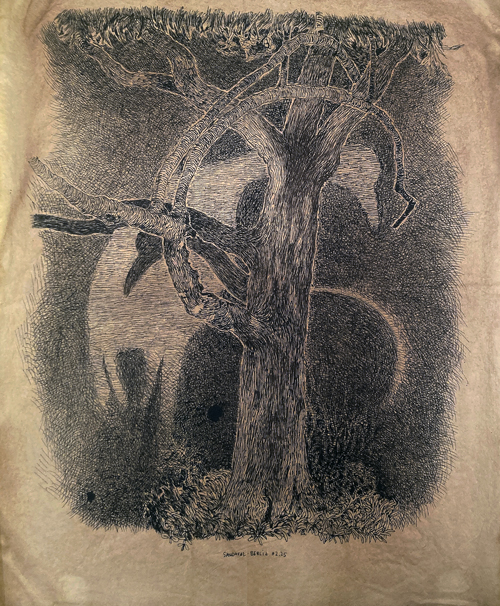
TENT VISIONS 08, 2025
Tent Visions Series (2025, WIP). Ink drawings made in the dark, in the forest. Not representations of what the eye sees — attempts to translate what my dog senses: subtle movements, fleeting presences, microscopic tremors just beyond human perception. Each mark is simultaneously a drawing and an act of attention to another species’ world. The hand is mine. The vision is not.
These four works do not form a sequence. They do not develop from each other. Each one is a separate attempt — a different entry into the same condition from a different direction.
Máquina Latina could have generated an entire catalogue of ensemble pieces, each one a variation on inherited failure. The Body of Ligia could have become a systematic exploration of the body as sonic cartography. It did not. The practice does not install itself in a zone of comfort where one work logically produces the next.
What drives the work is not development. It is impulse — the specific pressure of a particular problem that demands a particular solution. Each work is a resolution in both senses: a decision and an answer. The Threshold is not a method that generates a linear chain. It is a condition I return to, each time from a different place, each time requiring a different response. If this amounts to a method or a technique, others will have to decide — if at all.
Bibliography
• Beristáin, Helena. Diccionario de retórica y poética. Porrúa, Mexico City, various editions.
• Burkhart, Louise M. The Slippery Earth. University of Arizona Press, Tucson, 1989.
• Derrida, Jacques. The Truth in Painting. University of Chicago Press, Chicago, 1987.
• Garibay, Ángel María. Historia de la literatura náhuatl. Porrúa, Mexico City, 1953–1954.
• Garza, Mercedes de la. El universo sagrado de la serpiente entre los mayas. UNAM, Mexico City, 1984.
• Garza, Mercedes de la. Sueño y alucinación en el mundo náhuatl y maya. UNAM, Mexico City, 1990.
• Harvey, Graham. Animism: Respecting the Living World. Columbia University Press, New York, 2005.
• Heidegger, Martin. The Origin of the Work of Art. Harper & Row, New York, 1971.
• Hill Boone, Elizabeth. The Aztec World. Smithsonian Books, Washington, 1994.
• Hvidtfeldt, Arild. Teotl and Numen. Munksgaard, Copenhagen, 1958.
• León-Portilla, Miguel. La filosofía náhuatl. UNAM, Mexico City, 1956.
• López Austin, Alfredo. Cuerpo humano e ideología. UNAM, Mexico City, 1980.
• Maffie, James. Aztec Philosophy. University Press of Colorado, Boulder, 2014.
• Merleau-Ponty, Maurice. Phenomenology of Perception. Routledge, London, 1962.
• Schapiro, Meyer. Van Gogh. George Braziller, New York, 1950.
• Uexküll, Jakob von. A Foray into the Worlds of Animals and Humans. University of Minnesota Press, Minneapolis, 2010.
• Gran Diccionario Náhuatl. Universidad Nacional Autónoma de México, Instituto de Investigaciones Bibliográficas, Mexico City. gdn.iib.unam.mx