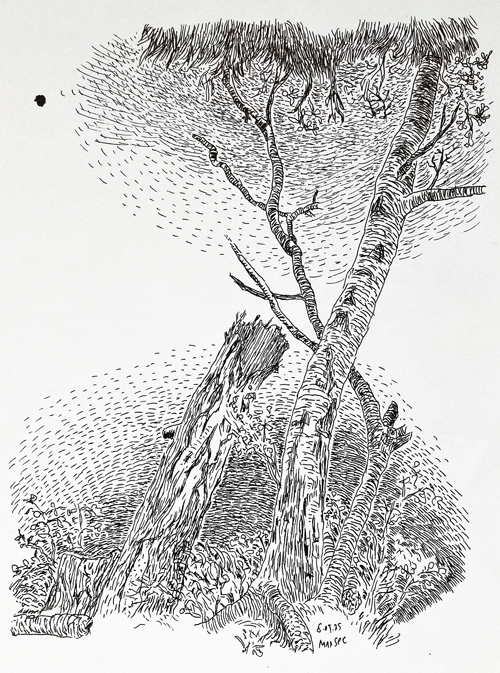
The trees in these drawings have no direction. Growth is not a trajectory here — it is a condition. The sky is also a soil. Both ends are ground. There is no up, no down, no origin, no destination — only the ongoing fact of being embedded.
I've been thinking about Deleuze and Guattari's (D&G) "rhizome" for the last two years, and something about it always bugged me. Not as a theory, as a simple childish expression: "We're tired of trees," they said. "Don't eat them then!" I wanted to answer.
As in a BBC documentary or a Disney film — where biological beings are taken hostage to suit a Shakespearean drama, with their respective "bad" or "good" characters — D&G cast the rhizome as the good guy and the tree as the bad guy. Rhizome? Free, non-hierarchical. Tree? Linear, oppressive, hierarchical, Freudian, the State.
They could do this by describing the rhizome only by its shape — no center, spreads sideways, any point can become a new point — and never asking what that shape actually does. Trees got the same treatment in reverse: reduced to their shape too, but read as the bad shape, the oppressive one. Ecology — the actual deals being made underground — never entered the picture for either one. That's exactly the kind of boxed-in, dichotomic, "binary" thinking they claimed to be escaping.
Trees are connected underground, trading nutrients, passing signals — no boss — but every single connection is a transaction. No center doesn't mean no deal. That's the part that got lost.
This year, 2026, a global study mapped these networks at a planetary scale — something like a hundred quadrillion kilometers of fungal threads, and the thickest networks weren't even in rainforests; they were in grasslands. Even at that size, nobody gets out of the deal.
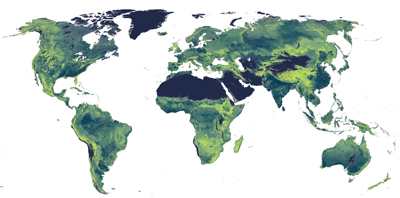
EMMA DILIC, NG STAFF.
SOURCE: J.D. STEWART, ET AL.
If you're going to use a biological being as a stand-in for a human condition, you can't ignore its ecological interactions — any more than you can describe a person while ignoring their social ones. Once ecological relations are removed from the metaphor, the rhizome becomes vulnerable to being read as an image of autonomy without obligation: free, no center, answerable to no one, detached from the dependencies that sustain it, and calling this condition liberation. No tree does that. Even the loneliest-looking tree in a field is trading with something underground. The isolation was never in biology. It was projected onto it.
I make these drawings as an argument, not an illustration. The ink on paper is the philosophical statement — not a picture of an idea but the idea itself, working itself out on the page. This is Field Logic in biological form.
References
/ Deleuze, Gilles, and Félix Guattari. A Thousand Plateaus: Capitalism and Schizophrenia. Trans. Brian Massumi. London: Bloomsbury, 1980/2014. / Simard, Suzanne W., et al. "Net Transfer of Carbon Between Ectomycorrhizal Tree Species in the Field." Nature 388 (1997): 579–582. / Stewart, Justin D., et al. "Global Density and Biomass of Arbuscular Mycorrhizal Fungal Networks." Science 392 (2026): 1171–1176. / Potter, Thea. "Radicle Thought, Vegetal Language and the Metaphorics of Pedogenesis." Rhizomes: Cultural Studies in Emerging Knowledge, no. 38 (2022).


.jpg)


