CARLOS SANDOVAL MENDOZA
Antilego
Germany, 2014–2015
Photo series
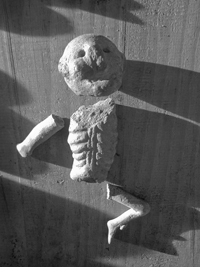
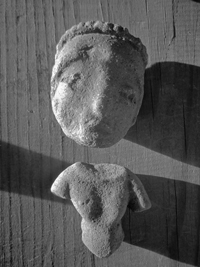
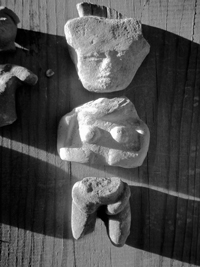
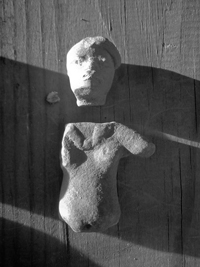
Dissociated pieces form arbitrary humans
|
Antilegos
Germany, 2015
Three chamber pieces
Composed from dissociated materials
|
Magazine Ixiptla, Spring 2014, Vol 1, ISBN 978-3-94-3514-25-4, Berlin, Germany
Magazine Ixiptla, Spring 2015, Vol 3, ISBN 978-3-94-3514-35-3, Berlin, Germany
In Cuernavaca, while making a photographic inventory of a family collection of pre-Hispanic terracotta fragments, I arranged the parts — heads looking at me, torsos breathing, limbs reaching nowhere — the way you instinctively would: into bodies. While editing the photographs, I realized I had accidentally made a historical portrait of conquered Mexico — I was in front of an Antilego, charged bodies assembled from pieces never designed to coincide.
Orlando Patterson, in Slavery and Social Death, names the deliberate mixing of enslaved peoples from different cultures and languages — stripping kinship, memory, and communication — as a foundational tool of domination. Guillermo Bonfil Batalla's México Profundo extends this logic to indigenous Mexico: a civilization systematically fragmented and rendered invisible by the colonial project, not destroyed but prevented from forming continuity on its own terms.
The fragments in the photographs are not ruins — they are México profundo in material form, survivors of that condition, still holding their particularity at the threshold between erasure and persistence. A field of elements in unresolved relation, where coherence is continuously interrupted or denied.
The operation has not ended. This photo series became the origin of Antilegos: three chamber pieces assembled from incompatible materials, performed as interludes between other works in the program. Broken, but self-contained — configurations that hold together without achieving integration, where structure exists as arrangement rather than resolution. This is the Uncoupled state of an acoustic field: elements placed in proximity, interacting locally, producing no shared convergence. The Antilego condition.
Antilegos
Germany, 2015
Three Chamber Pieces
1: Detuned, 4-line staff Keyboard and 2-channel video
2: Detuned, 4-line staff Oboe, violin and 2-channel video
3: Detuned, 4-line staff Clarinet, Viola and 2-channel video
2015: World Premiere, Strawinsky Saal, Donaueschinger Musiktage, Germany
2016, in ANTILEGOS, Kesselhaus, Kulturbrauerei, Berlin
2016 Austrian Premiere, in DISKRETE MASCHINEN, Klangspuren Schwaz,
Tiroler Festival für Neue Musik, Treibhaus Turm, Austria
Commission: Ensemble Mosaik
Antilegos 1. The performer's keyboard is split: the left hand draws from viola sounds, the right from electronics — two timbral worlds that don't resolve into a single instrument. The four-line staff, along with four levels of detuning, gives the performance a wide pitch bandwidth. On the two screens behind him, the same performer appears mirrored, reading at speed from a teleprompter — fragments of Carl E. Seashore's In Search of Beauty in Music, a psychologist's attempt to measure and systematize beauty, alternating with invented phonetic sequences — AU-Au / Taka-neka iuuu — rhythmic but meaningless, read with the same conviction as the Seashore. Occasionally he turns his head to listen to his other self. The live playing is simple, almost childlike. The video is a magpie.
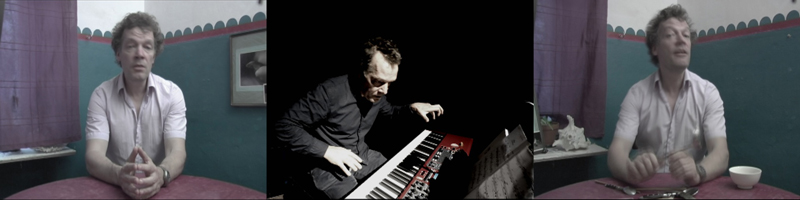
Antilegos 1, as premiered in Donaueschingen
Antilegos 2. Two performers play in unison — simple notes, lento, detuned tones, no extended techniques, no argument, almost whispering in the same breath. Just at the end they go a bit wild: no reed, and pizzicati. On the left screen, a time-lapse: the violin performer moves through a room with an action camera pointing at his face from a helmet, the frame lurching with every improvised gesture. On the right screen, the oboe performer at home, following a metronome — every click, he must play a single note, then immediately return to organizing the plates and glasses in his kitchen.
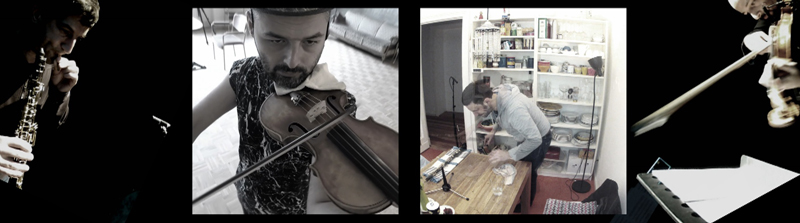
Antilegos 2, as premiered in Donaueschingen
Antilegos 3. The live performers wear white bathrobes — domestic, private, unguarded — playing something so gentle it almost disappears. On the two screens, filmed separately on different dates with a custom two-camera dolly, the same performers move through fast improvised music read from a moving teleprompter, the score alternating between written unison passages and the single instruction poco a poco Free, to poco a poco read notes. What appears on screen as simultaneity was never simultaneous. Extreme hyperactivity on screen, extreme calm and intimacy on stage.
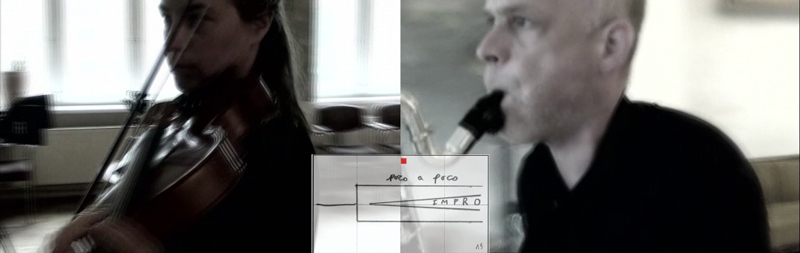
Antilegos 3, promo video. At the middle, the tablet teleprompter